Friday, June 13, 2008

June 12

The day after Gov. George C. Wallace sought to prevent the integration of the University of Alabama, a fertilizer salesman and Klan member named Byron De La Beckwith gunned down Medgar Evers in the driveway of his Jackson, Mississippi home. Just before 2:00 a.m. on 12 June 1963, Medgar Evers -- a 37-year-old father of three -- died at a local hospital.

Evers had few illusions about his life’s work. Several years before his death, Evers recalled his childhood in Decatur, Mississippi:
When I was eleven or twelve a close friend of the family got lynched. I guess he was about forty years old, married, and we used to play with his kids. I remember the Saturday night a bunch of white men beat him to death at the Decatur fairgrounds because he sassed back a white woman. They just left him dead on the ground. Everyone in town knew it but never [said] a word in public. I went down and saw his bloody clothes. They left those clothes on a fence for about a year. Every Negro in town was supposed to get the message from those clothes and I can see those clothes now in my mind's eye . . . . But nothing was said in public. No sermons in church. No news. No protest. It was as though this man just dissolved except for the bloody clothes . . . . Just before I went into the Army I began wondering how long I could stand it. I used to watch the Saturday night sport of white men trying to run down a Negro with their car, or white gangs coming through town to beat up a Negro.
A veteran of the segregated armed forces who fought in Normandy during World War II, Evers returned to the United States with a determination -- shared by millions of black soldiers and their compatriots -- to enjoy and exercise their full citizenship. He graduated from Alcorn State and sold insurance for a living, but he grew increasingly involved in the emerging civil rights movement, which was a deadly commitment in one of the most unreconstructed racist havens of the old South. Evers became involved in the investigation of Emmett Till’s murder in 1955, and he organized economic boycotts, prayer vigils and nonviolent marches, all of which earned him the respect of national civil rights leaders and the enmity of segregation’s defenders. Evers, who was his state’s first NAACP field officer, had been targeted by white supremacists for nearly a decade before his death. His home was firebombed, he received teleophe threats on a daily basis, and he was chased by racist drivers who more than once tried to run him over.

In his final speech, delivered less than a month before his death, Medgar Evers expressed optimism that
the years of change are upon us. In the racial picture things will never be as they once were. History has reached a turning point, here and over the world. Here in Jackson we can recognize the situation and make an honest effort to bring fresh ideas and new methods to bear, or we can have what Mayor Thompson called “turbulent times.” If we choose this latter course, the turbulence will come, not because of so-called agitators or the presence or absence of the NAACP, but because the time has come for a change and certain citizens refuse to accept the inevitable.
Byron De La Beckwith, refusing to “accept the inevitable,” shot Evers in the back and escaped justice for more than 30 years. At last convicted of the murder in 1994, De La Beckwith died of heart problems on 21 January 2001, the day after George W. Bush took the oath of office.

Labels: ,

|

Friday, March 07, 2008

March 7

On this date 1965, hundreds of civil rights activists walked across the Edmund Pettus Bridge, which would have led them out of Selma, Alabama, toward the state capital in Montgomery. The marchers were determined to press their governor -- the atrocious George W. Wallace -- to reign in the state’s police and troopers, who had been brutalizing justice advocates for years.

In early 1965 Martin Luther King, Jr., and the Southern Christian Leadership Conference had launched a voting rights campaign in Dallas County. Like many communities throughout the deep South, Dallas Country was dominated by the racist Sheriff Jim Clark who bragged that he had learned “never to his a nigger with your fist because his head is too hard.” In Dallas County, only 335 blacks -- out of a population of 15,000 -- were registered to vote, a percentage that was characteristic of Alabama as a whole.

The Selma protests quickly drew the official wrath of the state, which arrested thousands of civil rights activists during the first weeks of February. On February 18, a demonstration in nearby Marion had brought the death of Jimmie Lee Jackson, a 26-year old veteran and Baptist deacon whom a state trooper had shot at point-blank range during a police riot. Jackson -- who took a bullet to the abdomen while trying to protect his mother -- died from an infection on February 26. (His killer, James Bonard Fowler, was charged with murder a mere 42 years later.)

In response to Jackson’s death, the SCLC planned the Selma-to-Montgomery march for Sunday, March 7. After crossing the Pettus Bridge -- located on Jefferson Davis Highway (US 80) -- the marchers were greeted by a phalanx of Alabama Troopers. The subsequent assault was captured live by television crews and subsequently broadcast around the world. J.L. Chestnut, a young lawyer from Selma, recalled “Bloody Sunday” four decades later.
[W]hat I witnessed led me to believe America could not be saved and white people were not worth saving. One hundred fifty state troopers decked out in riot gear, tear gas, masks, and clubs the size of baseball bats, backed by fifty special deputy sheriffs mounted on nervous horses and armed with huge clubs, beat the young nonviolent people senseless in broad daylight . . .

People were left bloodied on the highway. [John] Lewis [of the Student Non-Violent Coordinating Committee] was on his knees, suffering from two concussions and bleeding like a stuck hog. Women and even children were unconscious, others semiconscious, lying, sitting, trying to run, but literally being run over by horses -- and hearing their ribs and limbs cracking. It was the worst day of my life.

Over the next two weeks, continuing violence in Alabama brought further attention to Selma and the broader question of black voting rights. On March 9, a white Unitarian minister from Boston named James Reeb was beaten by segregationist thugs in Selma; he died from head injuries two days later. After a federal court ruled on behalf of the SCLC, thousands of marchers left Selma on March 21. Among the marchers was a housewife and mother of five named Viola Liuzzo. Liuzzo had watched footage of the “Bloody Sunday” confrontation from her home in Detroit. Horrified by what she saw, Liuzzo traveled to Selma less than two weeks later and participated in the final march, which successfully arrived in Montgomery on March 24.

On March 25, Viola Liuzzo was shot to death in her car by four Klansmen. A little over four months later, Congress passed the Voting Rights Act; Lyndon Johnson signed it into law.

Labels: , ,

|

Tuesday, December 04, 2007

December 4

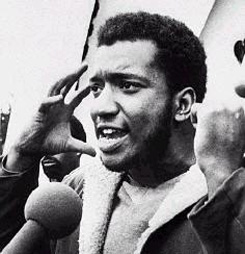
Just before 5:00 a.m. on this date in 1969, more than a dozen Chicago police officers stormed a house on the city’s west side; among their targets was a young community activist and Black Panther Party member named Fred Hampton, whom one of the officers proceeded to kill with a pair of point-blank shots to the back of his head.

During the years leading up to his death, Hampton had migrated from the NAACP -- through which he worked as a youth organizer -- to the Black Panthers, a revolutionary Marxist party whose Illinois chapter Hampton helped found. Although Hampton, like most members of the BPP, believed in the inevitability of socialist revolution, he spent most of his time developing social welfare programs like the Breakfast For Children, which offered free meals to kids in Chicago’s poorest neighborhoods. And while the Panthers prepared for the international proletarian struggle by arming themselves, they did so while living within the realm of Mayor Richard J. Daley, a genuine thug whose police enforced an Alabama-style racial apartheid.

Not surprisingly, relations between the city’s police and black community were less than warm. Skirmishes between the CPD and the Black Panthers -- most of them provoked by the former -- had become routine during the second half of 1969; with the encouragement of the FBI, which regarded the Black Panthers as a grave domestic threat, the Chicago police sought to completely uproot the organization. Hampton, who quite probably had been drugged the night before his death by an FBI informant named William O’Neill, did not wake up when the special operations unit burst in to the apartment, nor did he stir when his friend and fellow Panther Mark Clark was shot and killed in the living room. Even several bullet wounds to the shoulder -- all fired by the Chicago police -- were insufficient to get Fred Hampton out of bed.

The Chicago police initially claimed that Hampton had been killed in the confusion caused by an intense, 10-minute gun battle between the police and the handful of black revolutionaries sleeping in Hampton’s apartment. As it turned out, only a single shotgun blast -- fired from Mark Clark’s gun as he died -- came from any of the Panthers or their friends. No one was ever charged in the killing of Hampton, though civil suits brought by the families of Hampton and Clark were eventually settled out of court.

Hampton, one of the most gifted community organizers of his generation, was only 21 when he died. Aside from the false claim that a sleeping Hampton and his colleagues had initiated a gun battle, no specific reasons were ever cited for the raid.

Labels: , ,

|

Tuesday, April 03, 2007

April 3


Thirty-nine years ago today, Martin Luther King, Jr., arrived in Memphis, Tennessee to offer his support to the 1300 sanitation workers -- most of whom were African American -- who had struck nearly two months before to protest their low pay, awful working conditions and their union's non-recognition by the city. The civil rights leader had been to Memphis twice during the previous month and joined the men of AFSCME Local 1733 in marches to City Hall, sit-down protests, mass meetings and night-long vigils. During his final trip, King was ill. After joining in an afternoon march in downtown Memphis, King initially decided to rest and not speak that evening at the Bishop Charles Mason Temple Church of God, where workers and their supporters were planning to convene. After a 30-minute address by Ralph Abernathy, however, King rose and spoke extemporaneously for nearly 45 minutes.

Toward the end of his address, King observed that
[m]en, for years now, have been talking about war and peace. But now, no longer can they just talk about it. It is no longer a choice between violence and nonviolence in this world; it's nonviolence or nonexistence.

That is where we are today. And also in the human rights revolution, if something isn't done, and in a hurry, to bring the colored peoples of the world out of their long years of poverty, their long years of hurt and neglect, the whole world is doomed. Now, I'm just happy that God has allowed me to live in this period, to see what is unfolding. And I'm happy that He's allowed me to be in Memphis . . . .

Well, I don't know what will happen now. We've got some difficult days ahead. But it doesn't matter with me now. Because I've been to the mountaintop. And I don't mind. Like anybody, I would like to live a long life. Longevity has its place. But I'm not concerned about that now. I just want to do God's will. And He's allowed me to go up to the mountain. And I've looked over. And I've seen the promised land. I may not get there with you. But I want you to know tonight, that we, as a people, will get to the promised land. And I'm happy, tonight. I'm not worried about anything. I'm not fearing any man. Mine eyes have seen the glory of the coming of the Lord.
James Earl Ray shot King in the throat less than 24 hours later as King stood on the balcony of the Lorraine Motel, wondering if he needed to wear a coat that evening.

Labels:

|