Friday, June 13, 2008

June 12

The day after Gov. George C. Wallace sought to prevent the integration of the University of Alabama, a fertilizer salesman and Klan member named Byron De La Beckwith gunned down Medgar Evers in the driveway of his Jackson, Mississippi home. Just before 2:00 a.m. on 12 June 1963, Medgar Evers -- a 37-year-old father of three -- died at a local hospital.

Evers had few illusions about his life’s work. Several years before his death, Evers recalled his childhood in Decatur, Mississippi:
When I was eleven or twelve a close friend of the family got lynched. I guess he was about forty years old, married, and we used to play with his kids. I remember the Saturday night a bunch of white men beat him to death at the Decatur fairgrounds because he sassed back a white woman. They just left him dead on the ground. Everyone in town knew it but never [said] a word in public. I went down and saw his bloody clothes. They left those clothes on a fence for about a year. Every Negro in town was supposed to get the message from those clothes and I can see those clothes now in my mind's eye . . . . But nothing was said in public. No sermons in church. No news. No protest. It was as though this man just dissolved except for the bloody clothes . . . . Just before I went into the Army I began wondering how long I could stand it. I used to watch the Saturday night sport of white men trying to run down a Negro with their car, or white gangs coming through town to beat up a Negro.
A veteran of the segregated armed forces who fought in Normandy during World War II, Evers returned to the United States with a determination -- shared by millions of black soldiers and their compatriots -- to enjoy and exercise their full citizenship. He graduated from Alcorn State and sold insurance for a living, but he grew increasingly involved in the emerging civil rights movement, which was a deadly commitment in one of the most unreconstructed racist havens of the old South. Evers became involved in the investigation of Emmett Till’s murder in 1955, and he organized economic boycotts, prayer vigils and nonviolent marches, all of which earned him the respect of national civil rights leaders and the enmity of segregation’s defenders. Evers, who was his state’s first NAACP field officer, had been targeted by white supremacists for nearly a decade before his death. His home was firebombed, he received teleophe threats on a daily basis, and he was chased by racist drivers who more than once tried to run him over.

In his final speech, delivered less than a month before his death, Medgar Evers expressed optimism that
the years of change are upon us. In the racial picture things will never be as they once were. History has reached a turning point, here and over the world. Here in Jackson we can recognize the situation and make an honest effort to bring fresh ideas and new methods to bear, or we can have what Mayor Thompson called “turbulent times.” If we choose this latter course, the turbulence will come, not because of so-called agitators or the presence or absence of the NAACP, but because the time has come for a change and certain citizens refuse to accept the inevitable.
Byron De La Beckwith, refusing to “accept the inevitable,” shot Evers in the back and escaped justice for more than 30 years. At last convicted of the murder in 1994, De La Beckwith died of heart problems on 21 January 2001, the day after George W. Bush took the oath of office.

Labels: ,

|

Tuesday, April 08, 2008

April 8

The Emperor Marcus Aurelius Septimius Bassianus Antoninus -- known to the Roman world as Caracalla -- ascended to power in the year 211 upon the death his father, Septimus Severus. For a few months he shared the imperial duties with his brother Geta, but in December of that year, Caracalla decided to dispose of his fraternal rival. He arranged a meeting with Geta in his mother’s apartment, where a group of centurions hacked the unfortunate brother to bits.

After Geta had been assassinated and his body burnt to a crisp, Caracalla began a killing spree that solidified his reputation as one of the more bloodthirsty Roman leaders. He ordered his counselor Laetus -- with whom he had originally discussed the assassination plot -- to commit suicide, taking care to send him the poison himself. Other plotters and advisers met similar ends. One victim threw himself from a window to avoid his assassins; when he merely suffered a broken leg and tried to crawl away, his pursuers mocked him in the streets before finishing him off. As the Historia Augusta explains,
[d]uring this same time there were slain men without number, all of whom had favoured the cause of Geta, and even the freedmen were slain who had managed Geta's affairs. Then there was a slaughtering in all manner of places. Even in the public baths there was slaughter, and some too were killed while dining, among them Sammonicus Serenus, many of whose books dealing with learned subjects are still in circulation.... After this he committed many further murders in the city, causing many persons far and wide to be seized by soldiers and killed, as though he were punishing a rebellion.
Over the next four years, Caracalla presided over massacres in Gaul, in Germany, and in Egypt, where thousands of Alexandrians were put to death for little reason other than to remind the rest of the city of its subordinate relationship to Rome.

Loathed by apparently everyone, Caracalla died on this date in the year 217; he was assassinated will taking a piss on the side of the road hear Harran, a city on the edge of the Parthian Empire, which included all of modern-day Iran and much of modern-day Iraq.

Labels: , ,

|

Thursday, April 03, 2008

April 3

Forty years ago today, Martin Luther King, Jr., arrived in Memphis, Tennessee to offer his support to the 1300 sanitation workers -- most of whom were African American -- who had struck nearly two months before to protest their low pay, awful working conditions and their union's non-recognition by the city. The civil rights leader had been to Memphis twice during the previous month and joined the men of AFSCME Local 1733 in marches to City Hall, sit-down protests, mass meetings and night-long vigils. During his final trip, King was ill. After joining in an afternoon march in downtown Memphis, King initially decided to rest and not speak that evening at the Bishop Charles Mason Temple Church of God, where workers and their supporters were planning to convene. After a 30-minute address by Ralph Abernathy, however, King rose and spoke extemporaneously for nearly 45 minutes.

Toward the end of his address, King observed that
[m]en, for years now, have been talking about war and peace. But now, no longer can they just talk about it. It is no longer a choice between violence and nonviolence in this world; it's nonviolence or nonexistence.

That is where we are today. And also in the human rights revolution, if something isn't done, and in a hurry, to bring the colored peoples of the world out of their long years of poverty, their long years of hurt and neglect, the whole world is doomed. Now, I'm just happy that God has allowed me to live in this period, to see what is unfolding. And I'm happy that He's allowed me to be in Memphis . . . .

Well, I don't know what will happen now. We've got some difficult days ahead. But it doesn't matter with me now. Because I've been to the mountaintop. And I don't mind. Like anybody, I would like to live a long life. Longevity has its place. But I'm not concerned about that now. I just want to do God's will. And He's allowed me to go up to the mountain. And I've looked over. And I've seen the promised land. I may not get there with you. But I want you to know tonight, that we, as a people, will get to the promised land. And I'm happy, tonight. I'm not worried about anything. I'm not fearing any man. Mine eyes have seen the glory of the coming of the Lord.
James Earl Ray shot King in the throat less than 24 hours later as King stood on the balcony of the Lorraine Motel, wondering if he needed to wear a coat that evening.

Labels:

|

Monday, March 24, 2008

March 24

Arnulfo Romero y Galdámez, the Catholic Archbishop of San Salvador, was assassinated by members of a right wing death squad on this date in 1980; he was shot in the heart at the Hospital de la Divina Providencia, where he had been leading a funeral mass for a friend’s mother.

Romero had become an unlikely champion for the impoverished peasants of El Salvador, which was in the early stages of a civil war that would eventually claim more than 75,000 lives by the early 1990s. Until the mid-1970s, Romero was a resolutely conservative figure in the Catholic church, focusing on social problems like alcoholism and pornography while many of his peers scrutinized the economic injustices that had left most of the country landless, politically disenfranchised and desperately poor. After witnessing human rights abuses -- including a 1975 massacre at Tres Calles, a village in his own diocese -- Romero began to revise his understanding of the church’s relationship to the poor. Shortly after his 1977 appointment as Archbishop, Romero began to challenge the government openly; when his friend and fellow priest Rutilio Grande was assassinated in early March 1977, Romero publicly excommunicated the murderers and commenced a three-year nonviolent struggle in concert with El Salvador’s dispossessed.

During this time, the right-wing, authoritarian government of Carlos Romero -- who was not related to the Archbishop -- intensified its pressure on those in the Catholic church who espoused “liberation theology” or who otherwise advocated on behalf of the poor. Death squads and assassins gunned down at least six priests between 1977-1979, and in some villages the possession of religious materials became grounds for arrest. As the death squads accelerated their work, Romero frequently visited the garbage pits where the bodies had been dumped, looking for campseinos whose families had reported them missing.

By 1980, more than 3000 Salvadorans were being killed each month at the hands of government forces who were in many cases armed, trained and funded by the United States, which fretted about the spread of anything resembling communism in Latin America. Romero appealed to the United States to withhold its resources, to no avail.

On March 23, 1980, Romero urged the Salvadoran soldiers to cast down their weapons.
I would like to make an appeal in a special way to the men of the army, to the police, to those in the barracks. Brothers, you are part of our own people. You kill your own campesino brothers and sisters. And before an order to kill that a man may give, the law of God must prevail that says: Thou shalt not kill! No soldier is obliged to obey an order against the law of God. No one has to fulfill an immoral law. It is time to recover your consciences and to obey your consciences rather than the orders of sin…. In the name of God, and in the name of this suffering people whose laments rise to heaven each day more tumultuously, I beg you, I ask you, I order you in the name of God: Stop the repression!
Oscar Romero understood that his opposition to the government would likely cost him his life. As he explained in his final homily, however, “[O]ne must not love oneself so much, as to avoid getting involved in the risks of life that history demands of us, and those that fend off danger will lose their lives.”

The day after his appeal to the soldiers, Archbishop Romero joined the long list of Salvadoran martyrs. At his funeral, which was attended by nearly 250,000 people, government soldiers whot and killed as many as 50 mourners. Over the next 12 years, the US Congress and American Presidents Jimmy Carter, Ronald Reagan, and George H.W. Bush spent $1.5 million a day in support of the Salvadoran government. Archbishop Romero’s assassin was never captured.

Labels: , ,

|

Wednesday, March 19, 2008

March 19

Rene-Robert Cavelier De La Salle was killed by a single bullet to the head 321 years ago today at a spot about 70 miles northwest of what would later be the city of Houston. The French explorer was certainly not the last person to be murdered in Texas, but the circumstances of his passing were memorable nonetheless.

Credited with exploring the Louisiana territory and establishing (and botching) the first French colony on the Gulf of Mexico, La Salle was an audacious but badly organized, manic depressive and ill-tempered leader who eventually drew the murderous animosity of his men during his final adventure. While searching for the Mississippi River La Salle’s nephew, Moranget, became embroiled in a dispute over bison meat with the expedition’s surgeon, a man named Pierre Duhaut; Moranget accused them of setting aside the best meat and saving the marrow bones for themselves. On the night of March 18 Duhaut -- enraged by the accusations from a man he already loathed -- plotted with four other accomplices and killed Moranget and two others with an axe while they were asleep.

The next day, when La Salle arrived at the scene of the crime with a Recollet priest, he was dispatched as well. As one of the conspirators explained later
We followed them a few paces along the river as far as the fatal spot where two of the assassins were hiding on either side in the grass with their guns cocked. The first one missed his mark, but the other fired at the same time and with that single shot hit Monsieur La Salle in the head; he died one hour later.
The murderers stripped La Salle’s body and left it behind as the rest of the party continued on toward their destination at Fort Saint-Louis-des-Illinois. Accounts vary as to the final disposition of La Salle's corpse. Some accounts insist that the dead explorer was buried by his friend, Father Anastase Douay, who was with him when he died. Others explain that he was left unburied to be eaten by wild animals. Regardless of the truth, La Salle's body was never recovered.

Labels: ,

|

Thursday, February 21, 2008

February 21

Incas, a Carolina parakeet held captive at the Cincinnati Zoo, passed away on this date in 1918, less than a year after the death of his partner, Lady Jane. With Incas’ passing, the species Conuropsis carolinensis ceased to exist; it had been the only native species of parrot in North America, nesting in large trees from Florida to the upper Great Plains. When early 19th century deforestation reduced the birds’ access to cockleburs -- the species’ main source of food -- the birds turned upon the crops that were grown on the plantations and farms where their habitat used to be. In retaliation, farmers shot the Carolina parakeet in extraordinary quantities. To their ultimate disadvantage, carolinensis would swarm and circle over the slain bodies of their compatriots; this allowed even the least skilled shooters to destroy an entire flock in a matter of minutes. For many years in the mid-19th century, parakeet killers were able to sell the birds to hat-makers, who valued them for their attractive green and yellow feathers. By the 1880s the species had been diminished perilously; disease helped finish them off.

Forty-seven years after the extinction of the Carolina parakeet, Malcolm X was assassinated at the Audubon Ballroom in Harlem, where he was preparing to deliver a speech before an audience of 400 people. Although he was shot over a dozen times, it was a single shotgun blast to the chest that killed him. Three men -- former colleagues of Malcolm’s when he was with the Nation of Islam -- were later charged in the shooting, but conclusive evidence has never been put forth to explain who fired the fatal shot.

Herman Ferguson, who worked on a number of youth projects with Malcolm X, was in attendance at the Audubon and recalled the assassination years later.
As I glanced over in the middle rows . . . two brothers had jumped to their feet. One brother was facing another brother, who was backing off from him, and they both had their hands in their pockets. One of them said, "Get your hands out of my pocket, nigger," very loud, and everybody could hear this, and the place got quiet. Malcolm stepped out from behind the podium and took a step toward the stage, and leaned forward and said, "cool it brothers and sisters" . . . and as he started to straighten up, there was a loud blast that filled that auditorium with the sound of a weapon going off. Malcolm straightened up, and his hand came up, and he stiffened. . . . The shotgun blast was fired at him by one of the assassins . . . Then a fusillade of shots rang out . . . the sound of heavy caliber pistols like they were 45s, smaller caliber pistols like they were 38s., and this kept up for several seconds. And I remember saying, “If they would just stop firing, maybe he could survive this.
As Malcolm X lay dying, he was held by his friend Yuri Kochiyama, a Japanese-American activist, had moved to Harlem with her husband in 1960 and befriended Malcolm during the last two years of his life. Kochiyama, who had been interned at Jerome, Arkansas during World War II, believed that Malcolm X spoke on behalf of people of color everywhere. Malcolm X and Yuri Kochiyama share the same birthday, May 19.

Labels: ,

|

Friday, January 18, 2008

January 18

On this date 145 years ago, Mangas Colorado -- known to his fellow Beonkohes Apache as Red Sleeves -- was shot to death near Pinos Altos, New Mexico, while in the custody of a detachment of California Volunteers. Colorado, a towering warrior who had battled Mexicans and Anglo miners for decades, became an especially important target during a brutal conflict between the Apache and the United States Army that erupted during the early years of the American Civil War. In July 1862, Mangus Colorado and his son-in-law Cochise engaged the California Volunteers under Colonel James H. Carleton at the Battle of Apache Pass; only when a howitzer was unlimbered did the skirmish turn in favor of the Americans. Over the next six months, the California Volunteers conducted a ruthless campaign against the Apache, sacking villages and killing whomever they could manage.

By early 1863, the aging and wounded warrior -- who was indeed nearing 72 years old -- sought to arrange a peace. He was asked to come to Ft. McLane for consultation with US officials, who offered blankets, flour, beef and other supplies to Mangus Colorado and his people if they would resettle near the white settlement of Apache Tejo. The chief agreed to the arrangement, which turned out to be merely a pretext for taking him into custody on January 17, 1863.

In a letter written two years later, Joseph G. Knapp, a judge in New Mexico’s third district, described the events that followed just after midnight, January 18.
[Mangus Colorado was confined in the guardhouse; that night he was aroused from his sleep, some say that a soldier threw something and hit him, and others that he was punched with a pole, and because he raised himself up to see what had disturbed his sleep, he was instantly perforated with bullets and killed. Next morning at day dawn his lodge was attacked, and his wife and daughter shared the fate of husband and father. Not content with having killed a prisoner of war, without cause, your soldiers tore the scalp from his head and severed his head from his body, and after boiling the flesh, they exhibited the skull as a badge of honor, while the scalps of himself, his wife and daughter are worn as ornaments.
Cochise led reprisal attacks against the Union army and white settlers in New Mexico for years to come. The Cochise War, as it came to be known, raged for nearly a decade longer. The broader Apache resistance continued until 1886, when Geronimo surrendered with a mere 16 warriors at his side.

Labels: ,

|

Tuesday, December 04, 2007

December 4

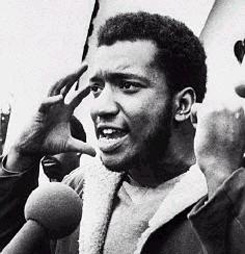
Just before 5:00 a.m. on this date in 1969, more than a dozen Chicago police officers stormed a house on the city’s west side; among their targets was a young community activist and Black Panther Party member named Fred Hampton, whom one of the officers proceeded to kill with a pair of point-blank shots to the back of his head.

During the years leading up to his death, Hampton had migrated from the NAACP -- through which he worked as a youth organizer -- to the Black Panthers, a revolutionary Marxist party whose Illinois chapter Hampton helped found. Although Hampton, like most members of the BPP, believed in the inevitability of socialist revolution, he spent most of his time developing social welfare programs like the Breakfast For Children, which offered free meals to kids in Chicago’s poorest neighborhoods. And while the Panthers prepared for the international proletarian struggle by arming themselves, they did so while living within the realm of Mayor Richard J. Daley, a genuine thug whose police enforced an Alabama-style racial apartheid.

Not surprisingly, relations between the city’s police and black community were less than warm. Skirmishes between the CPD and the Black Panthers -- most of them provoked by the former -- had become routine during the second half of 1969; with the encouragement of the FBI, which regarded the Black Panthers as a grave domestic threat, the Chicago police sought to completely uproot the organization. Hampton, who quite probably had been drugged the night before his death by an FBI informant named William O’Neill, did not wake up when the special operations unit burst in to the apartment, nor did he stir when his friend and fellow Panther Mark Clark was shot and killed in the living room. Even several bullet wounds to the shoulder -- all fired by the Chicago police -- were insufficient to get Fred Hampton out of bed.

The Chicago police initially claimed that Hampton had been killed in the confusion caused by an intense, 10-minute gun battle between the police and the handful of black revolutionaries sleeping in Hampton’s apartment. As it turned out, only a single shotgun blast -- fired from Mark Clark’s gun as he died -- came from any of the Panthers or their friends. No one was ever charged in the killing of Hampton, though civil suits brought by the families of Hampton and Clark were eventually settled out of court.

Hampton, one of the most gifted community organizers of his generation, was only 21 when he died. Aside from the false claim that a sleeping Hampton and his colleagues had initiated a gun battle, no specific reasons were ever cited for the raid.

Labels: , ,

|

Tuesday, November 27, 2007

November 27

Nearly three decades ago, on the morning of November 27, 1978, a 32-year-old former police officer and Vietnam veteran named Dan White assassinated San Francisco Mayor George Moscone and Supervisor Harvey Milk. White, who had served with Milk on the city Board of Supervisors until two weeks before the murders, shot the two men in what he would later claim was a depressed state of mind, evidenced in part by his excessive consumption of Twinkies and Coca-Cola during the previous few months. In death Milk -- who was openly gay -- became a martyr to the gay rights movement.

Described by friends as an “all-American” young man, Dan White had been elected to the 11-member Board in 1977 thanks in large part to his law and order ideology, which included thinly disguised campaign attacks on homosexuals, whom he regarded as threats to the entire city of San Francisco. As one of his campaign brochures explained, right-thinking people like himself would not stand idly by while their civilization crumbled at their feet:
[t]here are thousands upon thousands of frustrated, angry people waiting to unleash a fury that can and will eradicate the malignancies which blight our city. I am not going to be forced out of San Francisco by splinter groups of radicals, social deviates, incorrigibles.
After these “frustrated, angry people” carried him to victory, White clashed frequently with Moscone and Milk among others on the Board; in one of his more celebrated battles, he cast the only vote against a proposed city ordinance to bar discrimination against gays and lesbians.

Disgruntled with the position’s low pay and distressed by marital problems, White submitted his resignation in early November 1978. He changed his mind, however, several days later and asked Moscone to reappoint him. When Moscone refused, White loaded his revolver, came to City Hall and shot the mayor -- once in the chest and twice in the head -- in Moscone’s own office. Making his way to the other side of the building, White requested a brief conversation with Milk, whom he proceeded to shoot five times.

At his trial, Dan White successfully argued that the murders resulted from his depression, which diminished his capacity to sort out right from wrong. The jury, finding the “Twinkie Defense” plausible, found him guilty of manslaughter instead of first-degree murder. After serving five years at San Quentin, Dan White killed himself in October 1985.

Labels:

|

Monday, September 17, 2007

September 17

On this date in 1948, a small faction of terrorists carried out the assassination of Count Folke Bernadotte, a United Nations mediator from Sweden who was tasked with resolving the territorial disputes that lingered the aftermath of the 1948 Arab-Israeli War. The day before he was ginned down in his car, Bernadotte had released a second round of proposals for securing the existence of Israel and protecting the rights of Palestinians who had been displaced by the war. In addition to calling for the creation of two states in Palestine, Bernadotte proposed that their Jerusalem should be placed under international control and that refugees be allowed to return to their homes, in accordance with international law.

Bernadotte’s suggestions did not sit well with Lohamei Herut Israel (“Fighters for the Freedom of Israel”), a group initially formed during World War II with the intent of expelling Great Britain from Palestine. Lehi -- as the group was more commonly known -- carried out numerous bank robberies and dozens of assassinations over the course of its eight-year existence; its opposition to the British Mandate was so extraordinary that its leadership actually scoped out friendly relations with Germany during the war. Following British restrictions on Jewish immigration to Palestine in 1939, radical Zionist groups such as Lehi hoped that Germany’s leaders -- whose anti-Semitism was already quite renowned -- might offer Jews quick passage to the Holy Land in exchange for the group’s cooperation in fighting a common enemy.

Lehi’s offers to assist the Nazis, however, were never acknowledged. After the war, the group continued to resist British influence in Palestine, even after it formally ended its mandate and surrendered its responsibility to the newly formed United Nations. Bernadotte -- whose assignment required him to balance the competing interests of numerous parties -- fell victim to a style of radicalism that would become all too familiar over the next six decades.

Ambushed by four members of Lehi who were riding in a jeep, Count Folke Bernadotte was shot in the chest and died instantly.

On the 30th anniversary of Bernadotte’s assassination, Israel and Egypt agreed to a treaty that ended the state of hostility that had existed between the two nations since the 1948 War. The Israeli Prime Minister at the time was Menachem Begin, who during World War II had been a member of Irgun, another anti-British paramilitary group. The Egyptian President Anwar Sadat, a former army officer, had also opposed Great Britain during World War II -- an opposition born out of 60 years of British colonialism in his homeland. Like Lehi, Sadat and the so-called Free Officers had sought an alliance with the Axis Powers, including Nazi Germany, during the war.

Meeting a fate that resembled Count Bernadotte’s, Anwar Sadat fell to assassins three years after the Cam David Accords were signed.

Labels: , ,

|

Thursday, September 06, 2007

September 6

According to a long-time White House doorman named Theodore Pendel, William McKinley enjoyed a good handshake. In his 1902 memoir, Pendel explained that
[t]he President always took great delight in shaking hands with the people. He told one of the officials at the White House that he took more delight in shaking hands with the people than he did at one of the state dinners. It seemed to be a great gratification to him to meet the masses of the people.
Shortly after 4:00 p.m. on September 6, 1901, an anarchist named Leon Czolgosz shot McKinley in the chest and stomach while the president was presumably having the time of his life, shaking hands with his adoring public at the Pan-American Exposition in Buffalo, New York.

Although it initially appeared that McKinley might survive his wounds, he eventually succumbed to pancreatic necrosis after eight lingering days. At his funeral, Rev. Morgan Dix -- son of former New York governor John Dix -- hyperbolized about the third presidential assassination in four decades. Calling attention to the perils of anarchism, Dix asked
will the nation fail to act as a great nation should, to deal as it ought to do with the most deadly foe that it has or ever can have? For if this foe prevails, the nation, the state, the law, the government will disappear forever and ever. Are we to forget what has thrown us into this present mourning and these tears? Are we to lapse into a fatal apathy, and let the preaching of murder and inciting to murder and the applauding of murder go on as before? Are the laws still to protect the very persons who hate and detest them and are banded together for the overthrow of society? It seems to me that the most solemn issue of the hour is as to what we have to do who remain—whether we are equal to the occasion. Are we now to fall back before this enemy, the last and most dangerous we have ever encountered or ever shall, and let things drift from bad to worse, in new instances of a passion which spares not one life that stands in its way?
Czolgosz, who was nearly beaten to death by infuriated bystanders after the shooting, was taken into custody and quickly tried for McKinley’s murder; to no one’s surprise, he earned a guilty verdict and a sentence of death, which was carried out on October 29, six weeks after McKinley's demise. At his electrocution, Czolgosz expressed no regrets and issued no apologies for the assassination.

"I killed the President," he said, "because he was the enemy of the good people, the good working people. I am not sorry for my crime."

Labels: ,

|

Thursday, July 26, 2007

July 26

Fifty years ago today, Carlos Castillo Armas was gunned down by a palace guardsman in Guatemala City, where he had ruled for three years as military dictator of a nation inching its way toward civil war. Castillo Armas, a former US-trained Guatemalan military officer who had already plotted -- unsuccessfully -- against his own government 1950, had fled to Honduras to escape arrest. There, he sold furniture and dreamed of returning home to crush the leftists he believed were ruining the land of his birth.

Backed by the United States, which objected among other things to the land reforms being carried out by president Jacobo Arbenz, Castillo Armas organized an army that eventually took control of Guatemala, deposing Arbenz in June 1954. By September, Castillo had been formally installed as president and immediately began a process of disenfranchising the population; before long, half of Guatemala had surrendered it right to vote. By revoking Decree 900, Castillo also forcefully removed tens of thousands of peasants from the lands they had acquired under the Arbenz government, and he established -- at the behest of the American CIA -- an organization that later became one of the first death squads in central America, the National Committee of Defense Against Communism. The Committee developed a list of 72,000 supposed “Communists” and began detaining suspects immediately under the Preventive Penal Law, which denied the accused of any rights to counsel or appeal.

Ironically, Carlos Castillo Armas came to be viewed by military rivals as being “soft” on communism. Although the Eisenhower administration pumped $80 million into Guatemala over the next three years, Castillo was unable to manage a failing economy and unable to quell widespread social discontent. Noting that Castillo was unlikely to remain in power for long, Keith Morgan observed in Harper’s magazine in July 1955 that “Guatemala may be caught in a revolving door.”

By the end of the decade, Morgan’s understated prediction turned out to be accurate. Castillo Armas was shot through the heart on his way to dinner on July 26, 1957. Over the next few months, four different successors held the office of president, some for as little as two days. From 1960 to 1996, Guatemala endured dozens of coups and counter-coups, as civil war took as many as 250,000 lives and displaced more than a million people.

Last year's entry:Nikephoros I and Ed Gein

Labels: , ,

|

Tuesday, June 05, 2007

June 5

5 June 1968.

Labels:

|

Monday, March 19, 2007

March 19

Rene-Robert Cavelier De La Salle was killed by a single bullet to the head three hundred and twenty years ago today at a spot about 70 miles northwest of what would later be the city of Houston. The French explorer was certainly not the last person to be murdered in Texas, but the circumstances of his passing were memorable nonetheless. Credited with exploring the Louisiana territory and establishing (and botching) the first French colony on the Gulf of Mexico, La Salle was an audacious but badly organized, manic depressive and ill-tempered leader who eventually drew the murderous animosity of his men during his final adventure. While searching for the Mississippi River La Salle’s nephew, Moranget, became embroiled in a dispute over bison meat with the expedition’s surgeon, a man named Pierre Duhaut; Moranget accused them of setting aside the best meat and saving the marrow bones for themselves. On the night of March 18 Duhaut -- enraged by the accusations from a man he already loathed -- plotted with four other accomplices and killed Moranget and two others with an axe while they were asleep.

The next day, when La Salle arrived at the scene of the crime with a Recollet priest, he was dispatched as well. As one of the conspirators explained later
We followed them a few paces along the river as far as the fatal spot where two of the assassins were hiding on either side in the grass with their guns cocked. The first one missed his mark, but the other fired at the same time and with that single shot hit Monsieur La Salle in the head; he died one hour later.
The murderers stripped La Salle’s body and left it behind as the rest of the party continued on toward their destination at Fort Saint-Louis-des-Illinois. Accounts vary as to the final disposition of La Salle's corpse. Some accounts insist that the dead explorer was buried by his friend, Father Anastase Douay, who was with him when he died. Others explain that he was left unburied to be eaten by wild animals. Regardless of the truth, La Salle's body was never recovered.

Labels: ,

|

Thursday, March 15, 2007

March 15


The middle of March, 44 BCE was not looking so good for Gaius Julius Caesar. Though he had recently been appointed dictator for life over Rome and was positively drowning in formal honors bestowed on him by the Senate, Caesar had reason for concern. Rumors abounded of plots against him, and a series of bizarre events foretold great unpleasantness to come. A bronze tablet, for instance, had recently been excavated from the tomb of Capys, founder of Capua, warning that its discovery would be followed by a terrible murder of great significance to the Roman people. More strangely, the herd of horses Caesar had brought with him across the Rubicon had suddenly refused to graze and were observed actually weeping in the fields. A soothsayer named Spurrina had also given warning to the dictator that peril was afoot, and on March 14 a king bird flew into the Hall of Pompey (named for Caesar’s vanquished foe) and was torn to pieces by various other birds in pursuit from a nearby grove. Finally, on the night before his death, both Caesar and his wife Calpurnia each experienced strange dreams -- Casear saw himself flying through the air, while Calpurnia dreamed of clutching her husband’s murdered body. During Calpurnia’s dream, the door of their bedroom suddenly flew open.

The following day, Caesar -- undeterred by the mountain of evidence that he was about to perish -- took to the forum on the invitation of numerous senators, who claimed to have a petition for him to examine. The first century Roman historian Seutonius explains what transpired:
As he took his seat, the conspirators gathered about him as if to pay their respects, and straightway Tillius Cimber, who had assumed the lead, came nearer as though to ask something; and when Caesar with a gesture put him off to another time, Cimber caught his toga by both shoulders; then as Caesar cried, “Why, this is violence!” one of the Cascas stabbed him from one side just below the throat. Caesar caught Casca’s arm and ran it through with his stylus, but as he tried to leap to his feet, he was stopped by another wound. When he saw that he was beset on every side by drawn daggers, he muffled his head in his robe, and at the same time drew down its lap to his feet with his left hand, in order to fall more decently, with the lower part of his body also covered. And in this wise he was stabbed with three and twenty wounds, uttering not a word, but merely a groan at the first stroke, though some have written that when Marcus Brutus rushed at him, he said in Greek, “You too, my child?” All the conspirators made off, and he lay there lifeless for some time, and finally three common slaves put him on a litter and carried him home, with one arm hanging down. And of so many wounds none turned out to be mortal, in the opinion of the physician Antistius, except the second one in the breast.
The common people of Rome rampaged through the streets after Caesar’s death, setting fires and seeking out the conspirators, whom they intended to destroy. The conspirators were spared, though few of them came to good ends. During the civil war that followed Caesar’s death, Brutus committed suicide and Cassius ordered his own freed slave to kill him.

Labels: ,

|