Tuesday, June 17, 2008

June 17

On this date in 1939, the German-born serial killer Eugen Weidmann lost his mind – and the head that encased it – to the guillotine outside the French prison at Versailles.

Weidmann had committed a number of petty crimes over the years and had completed a short prison term in March 1936 before meandering to France to avoid serving in Hitler’s armed forces. It appears that Weidmann viewed himself to be something of a criminal genius, and he organized a gang comprised of fellows he’d met while in a Franfurt prison to carry out a series of abductions that mainly targeted wealthy visitors from the United States and Great Britain. When their first effort went badly and their victim managed to escape, Weidman and his companions evidently decided to take no more chances. Beginning with the abduction and murder of the American dancer Jean de Koven – whom he admitted to strangling while she was drinking tea -- Weidman and his accomplices tallied a half dozen victims between July and September 1937. Most of them had been shot in the back of the head and robbed; one of their female victims was buried in a garden, the other stuffed into a cave. Detectives located and arrested the conspirators in December, and their trial – which did not take place for another 15 months – resulted in the completely predictable verdict of death for Weidman. His accomplices earned life sentences.

At 4:00 a.m. on June 17, 1939, prison officials roused Weidmann from bed, shaved the back of his neck, offered him a shot of rum and a smoke, then escorted him the Place de Greve, a public plaza just outside the prison walls. More than two hundred audience permits had been issued to view the killing, and so an eager crowd awaited the condemned man as he emerged from Versailles. Most of them had been merry-making since the previous evening in anticipation of the execution, and Weidman’s arrival rejuvenated their fatigued spirits, sending them into what the press described as a “hysterical” frenzy. When Henri Desfourneaux, France’s executioner, released the blade, Weidman’s head tumbled to the pavement while numerous women in the crowd surged forward to dip their handkerchiefs and scarves in the accumulating lake of blood.

Embarrassed by the display, prison authorities consigned future executions to the interior of the prison, where they ere carried out until 1977, when the last guillotining took place. France, joining much of the rest of the world in its evolving standards of decency, formally abolished capital punishment in September 1981.

Labels: ,

|

Thursday, March 20, 2008

March 20

When Martha M. Place threw sulfuric acid into her daughter’s face and smothered her with a pillow in February 1898, she probably was not angling to become the first American woman to die in the electric chair. Yet the Brooklyn dressmaker achieved precisely that status a little over thirteen months later, when on 20 March 1899 she was strapped into the novel device at Sing Sing prison and followed her 17-year-old child into the void.

Place was described in the press as "homely, old, ill-tempered, not loved by her husband." According to prison officials -- who carried out the execution after Governor Theodore Roosevelt refused to commute the sentence -- her electrocution was quick and efficient.

Thirty-four years after the life of Martha Place shuddered to a conclusion, the State of Florida executed bricklayer Giuseppe Zangara for the crime of murder. Zangara, a naturalized American citizen from Italy, had attempted to assassinate President-elect Franklin Roosevelt a month earlier in Miami. Zangara, who had suffered from acute stomach ulcers since childhood, was convinced that if he killed the leader of the capitalist world, he would be delivered from his excruciating physical pain -- and that he could alleviate the economic catastrophe that had immiserated millions over the previous four years.

In early 1933, he purchased a gun for $4 and on February 15 brought it to Bayfront Park in Miami, where Roosevelt was scheduled to appear that day. There, the five-foot-tall Zangara stood on top of a wooden chair and shot five people, none of whom was his intended target. Four of the wounded survived. Chicago Mayor Anton Cermak, however, took a bullet to the chest and died on March 6. Two weeks after Cermak’s death, Zangara was executed at the state prison in Raiford. Had Cermak lived, Zangara would have spent at least 84 years in prison -- the sentence he had already received for trying to kill Roosevelt.

As he was being strapped into the chair, Guiseppe Zangara remained feisty and unrepentant. "Viva Italia!" he cried.
Goodbye to all poor peoples everywhere! Lousy capitalists! No picture! Capitalists! No one here to take my picture. All capitalists lousy bunch of crooks. Go ahead. Push the button!
Sixty-two years after Zangara’s anti-capitalist tirade, the state of Oklahoma executed Thomas Grasso by lethal injection, punishment he received for killing two elderly women (one of whom he strangled with her own Christmas tree lights on Christmas Eve 1990). Grasso had been serving a 20-year sentence in New York for one of the murders; although Grasso was sentenced to die in Oklahoma for the murder of 87-year-old Hilda Johnson, New York Governor Mario Cuomo refused to send him back -- even though Grasso, by his own account, desperately wanted to die. When George Pataki campaigned for Cuomo’s job in 1994, he promised to help Grasso fulfill his wish. Pataki won the election, and Grasso returned to Oklahoma. He refused to appeal his capital sentence, and so the state quickly scheduled his execution.

On 20 March 1995, Thomas Grasso sat down to his last meal -- a dozen steamed mussels, a Burger King double cheeseburger, a can of spaghetti with meatballs, a mango, half a pumpkin pie with whipped cream, and a strawberry milkshake. Grasso’s last meal was more notable, however, for what it lacked. In his final statement, Grasso announced that “I did not get my Spaghetti Os -- I got spaghetti. I want the press to know this!"

In a separate written statement released to the press before his death, Grasso wrote that “What we call the beginning is often the end, and to make an end is to make a beginning. The end is where we start from.” Almost no one recognized that Grasso’s statement came from “Little Gidding,” one of T. S. Eliot’s Four Quartets.

Labels:

|

Tuesday, March 04, 2008

March 4

If the various accounts are to be trusted, a Roman guard named Adrian (or Hadrian) was martyred on this date in the year 306. According to legend, Adrian -- who hailed from Nicomedia -- was inspired to a sudden conversion when he witnessed a group of Christians being led in chains to their tortuous imprisonment and predictable execution. Declaring himself a Christian as well, the guard surrendered himself and joined his new brothers and sisters. His young wife Natalia, far from being irritated with her husband’s decision, is alleged to have wept with glee at the news; she was, it turns out, herself a Christian already.

Following her husband’s trial, during which he was beaten and lashed, Natalia was allowed for some reason to be present at his dismemberment. Indeed, she helped the executioners fulfill their obligation to separate Adrian from his hands and feet. As told by Sabine Baring Gould’s 19th century chronicle of The Lives of the Saints, Natalia lifted her husband’s “dear feet” and placed them “reverently and tenderly” on the block.
Then, the executioner smote and crushed the bones and next with an axe hewed off the feet.

Natalia, who had stationed herself at the head of him she loved best in all the world, said, with her eyes on his face, “Servant of Christ! if you live put out your hand to mine!” And the dying man feebly stretched out his hand, as though groping for hers, and she caught it and held it and laid it on the anvil; then the executioner brought his axe down and hewed it off as she clasped it. And she folded it in her mantle to her heart, and watched the colour die out of the cheeks of Adrian and his eyes grow dim. She closed them with her loving hand.
In customary fashion, the body of St. Adrian was parceled out over subsequent centuries to churches and shrines across Europe -- an arm in Léon, a jawbone and half an arm in Cologne, another half-arm in Prague, an armless corpse in Raulcourt, teeth in Hainault and Flanders, a head in Bologna, and various bones in Agincourt, Douai, Bruges and at Mecheln. Belgian churches alone three rival bodies, each of which was supposed to have been that of Adrian, the patron saint of butchers, arms dealers, epilepsy and the plague.

Labels: ,

|

Wednesday, February 27, 2008

February 27

On this date in 1864 Union prisoners of war began arriving at Camp Sumter, Georgia, otherwise known as Andersonville Prison. Over the next year, over 45,000 prisoners would be received at Andersonville. Due to unspeakably filthy conditions and inadequate supplies of food and clean water, more than 13,000 of those soldiers -- as well as numerous Confederate guards -- would perish of malnutrition and disease before the camp was liberated at the end of the war. Most would succumb between August and December 1864, a period that saw an average of 100 deaths per day.

By any account, Andersonville offered a squalid glimpse into hell. Sgt. David Kennedy, 9th Ohio Cavalry, wrote in his journal on 9 July 1964'
Wuld that I was an artist & had the material to paint this camp & all its horors or the tounge of some eloquent Statesman and had the privleage of expresing my mind to our hon. rulers at Washington, I should gloery to describe this hell on earth where it takes 7 of its ocupiants to make a shadow.
Clara Barton, visiting the grounds of Andersonville a year later after the camp had closed, wrote with horror of what she had seen there:
Think of thirty thousand men penned by close stockade upon twenty-six acres of ground, from which every tree and shrub had been uprooted for fuel to cook their scanty food, huddled like cattle, without shelter or blanket, half-clad and hungry, with the dreary night setting in, after a day of autumn rain. The hill-tops would not hold them all, the valley was filled with the swollen brook; seventeen feet from the stockade ran the fatal dead-line, beyond which no man might step and live. What did they do? I need not ask where did they go, for on the face of the whole green earth there was no place but this for them; but where did they place themselves? How did they live? Ay! How did they die? But this is only one feature of their suffering ; and perhaps the lightest. Of the long dazzling months when gaunt famine stalked at noon-day, and pestilence walked by night; and upon the seamed and parching earth the cooling rains fell not, I will not rust me to speak. I scarce dare think. If my heart were strong enough to draw the picture, there are thousands upon thousands all through our land too crushed and sore to look upon it. But after this, whenever any man who has lain a prisoner within the stockade of Andersonville, would tell you of his sufferings, how he fainted, scorched, drenched, hungered, sickened, was scoffled, scorged, hunted and persecuted, though the tale be long and twice told, as you would have your own wrongs appreciated, your own woes pitied, your own cries for mercy heard, I charge you, listen and believe him. However definitely he may have spoken, know that he has not told you all.
Henry Wirz, a Swiss doctor from Louisiana, served as prison commandant during that year. For his efforts, such as they were, Wirtz was hanged in November 1865. His last fourteen minutes of life were spent at the end of a rope that was too short, listening to Union soldiers taunt him with cries of “Andersonville! Andersonville!” as he slowly choked to death. Remarkably, he was the only Confederate official to be executed for war crimes.

Labels: , ,

|

Tuesday, February 12, 2008

February 12

Lady Jane Grey, the so-called “Nine Day Queen,” lost her head at the Tower of London 454 years ago today.

Grey, a devout worshipper in the Protestant Church of England, was installed on the throne following the death of Edward VI; to her supporters, her chief qualification was that she was not Mary Tudor, her own cousin. Tudor, one of the daughters of the former King Henry VIII, was a committed Catholic, and her faith brought great anxiety to those who feared the return of the English crown to influence of the popish devils. Through a complex series of machinations devised almost entirely by her father-in-law, John Dudley, Duke of Northumberland, Jane Grey was announced as the successor to Edward VI following his July 1553 death. Unfortunately for the new Queen, popular support for Mary -- her Catholicism notwithstanding -- led quickly to Grey's replacement barely a week after her reign began.

Imprisoned in the Tower with her husband, Guildford Dudley, Lady Jane was convicted and sentenced to die for treason in November 1553. No one, however, expected Queen Mary to allow the sentence to proceed. Indeed, Jane Grey would quite probably have enjoyed a long -- and eventually free -- life had not her father, the Duke of Suffolk, attempted a revolt against the new Queen Mary in January 1554. Somewhat reluctantly, the Queen accepted her advisers' counsel that so long as Jane Grey remained alive, she would serve as a beacon for zealous, rebellious protestants. Grey -- who had nothing to do with her father's plot -- was executed on 12 February 1554, an hour after her husband was similarly beheaded. After she was escorted to the scaffold and blindfolded, Jane Grey delivered her last address to the small audience:

Before God and the face of you, good Christian people, this day I pray you all, to bear me witness that I die a true Christian woman, and that I look to be saved by none other means, but only by the mercy of God, in the merits of the blood of his only son, Jesus Christ. And I confess, when I did know the word of God, I neglected the same, loved myself and the world, and thereto the plague or punishment is happily and worthily happened unto me for my sins. And yet, I thank God of His goodness that he hath thus given me a time and respite to repent. And now good people, while I am alive, I pray you to assist me with your prayers.'
After her prayer, Jane Grey was blindfolded and made to kneel. Unable to find the block of wood where she was to rest her head for the last time, the young girl began to panic. After a bystander helped the condemned to the right spot, her executioner finished the job. Jane Grey was 16 years old.

***

Today we remember the hapless epicure Adolf Frederick I, who reigned as King of Sweden from 1751 until his death in on this date in 1771. His two decades on the throne were significant only to the extent that he presided helplessly over the decline of the Swedish kingdom. As sovereign, Frederick I was almost completely powerless and functioned more or less as an ornament while the riksdag managed the affairs of state, which included Sweden’s commitment to the Seven Years’ War -- the first truly global war in human history, provoked by a poisonous mixture of European internal politics and colonialism.

Among his passions in life, Frederick was an avid collector of biological specimens. During his years as the Swedish crown prince, he served as an important resource for Carl Linnaeus, who studied the prince’s cabinet while sorting out the details of his famous taxonomic system. On February 12, 1771, Frederick’s two decades of idle monarchy came to an end. That night, he gathered his final collection of specimens, which included a titanic feast of lobster, caviar, sour cabbage, smoked herring and champagne. For dessert, the king gobbled fourteen servings of semla, a traditional wheat pastry usually served in warm milk. He died that night -- propped up on Queen Louisa Ulrica’s knees -- of a massive digestive event.

Labels: ,

|

Thursday, January 31, 2008

January 31

American Private Eddie Slovik was shot for desertion on this date in 1945. He had abandoned the 109th Infantry Regimen, 28th Infantry Division in October 1944, just two months after arriving in France. Because of his record of petty criminality as a youth in Detroit, Slovik was originally declared unfit for military service in 1942. As the meat-grinder of war proceeded, however, his classification was changed and Eddie Slovik was declared fit for duty in 1944. Slovik was despondent during basic training and announced his intent to “run away” from his assignment, believing that he would spend at most a few months in prison. Instead, a nine-man jury convicted him of violating the 58th Article of War in November 1944 and sentenced him to death by firing squad.

Slovik appealed to General Dwight David Eisenhower for clemency but was denied two days before Christmas; desertion had become a problem among US soldiers, and the General was eager to set a deterrent example. Sixty-two years ago today, Eddie Slovik's sentence was carried out near the French village of Ste Marie aux Mines. Of the 49 American deserters sentenced to die during the war, Slovik’s sentence was the only one not commuted. In addition to Pvt. Slovik, 21,048 American soldiers deserted their units during World War II.

Just before he was shot, Slovik was urged by one of his executioners "take it easy, Eddie. Try to make it easy on yourself -- and on us."

"Don't worry about me," Slovik responded. "I'm okay. They're not shooting me for deserting the United Stated Army -- thousands of guys have done that. They're shooting me for bread I stole when I was 12 years old."

In the last letter he ever wrote, Slovik mused to his wife that “Everything happens to me. I've never had a streak of luck in my life. The only luck I had in my life was when I married you. I knew it wouldn't last because I was too happy. I knew they would not let me be happy.”

Antoinette Slovik had never actually been told that her husband was to be shot. The army insisted afterward that the young private should have told her himself. Riven with grief and anger, Antoinette struggled to clear her husband’s name until her own death in 1979. She asked seven American presidents -- including Dwight Eisenhower -- to issue her husband a pardon. All refused.

Labels: ,

|

Wednesday, January 30, 2008

January 30

Today is the anniversary of the "Bloody Sunday" massacre in Derry, Northern Ireland in 1972. During a routine protest against British rule, soldiers from the British Parachute
Regimen shot 26 unarmed demonstrators in the Bogside area of Derry, which had been a nationalist stronghold for two years. When British commanders received erroneous word that Irish Republican Army snipers were among the crowd, live rounds replaced rubber bullets and thirteen people died; a fourteenth died several months later from the wounds he received that day. Most of the dead and injured were shot as they fled the paratroopers, and none were armed. General Sir Robert Ford, commander of land forces in Northern Ireland, claimed after the melee that his troops had fired only three shots.

According to the Coroner’s report, issued 20 months after the attack,
[T]he Army ran amok that day and shot without thinking what they were doing. They were shooting innocent people. These people may have been taking part in a march that was banned but that does not justify the troops coming in and firing live rounds indiscriminately. I would say without hesitation that it was sheer, unadulterated murder.

The Widgery Commission Report, which whitewashed the events of 30 January 1972, found that the army's conduct had merely "bordered on the reckless."

***

Oliver Cromwell, military commander of the Protestant armies during the English Civil War and Lord Protector of the Commonwealth of England from 1653-1658, was executed at Tyburn gallows on this date in 1661. A decade before, following English tradition, Cromwell himself had laid waste to northeastern Ireland. After being hanged, Cromwell was decapitated; while his head was mounted on a post and displayed outside Westminster Abbey, his body was reportedly dumped into a common pit. The head remained on display until 1685. It was not buried, however, until 1960.

Oddly enough, on the day of his beheading, Oliver Cromwell had already been dead for two years, having expired from malaria and a kidney infection in September 1658. Nearly a decade before his own death, Cromwell had successfully urged Parliament to execute Charles I for treason, an execution that was carried out in public on 30 January 1649. Cromwell famously described the beheading of Charles I -- twelve years to the day before his own -- as a “cruel necessity.” When the royalists recaptured power in 1660, Cromwell was convicted posthumously of the same crime for which Charles had been dispossessed of his own head. John Bradshaw, who had presided over Charles' trial in 1649, was drawn and quartered along with Cromwell; Parliamentary generals Henry Ireton and Thomas Pride were handled in more or less the same fashion.

All three happened to be dead as well.

Labels: ,

|

Sunday, January 20, 2008

January 20

On this date in 2001, George Walker Bush formally ascended to the office of President of the United States. In that day's inaugural address, speechwriter Michael Gerson -- addressing the nation via the new president -- announced that
America remains engaged in the world by history and by choice, shaping a balance of power that favors freedom. We will defend our allies and our interests. We will show purpose without arrogance. We will meet aggression and bad faith with resolve and strength. And to all nations, we will speak for the values that gave our nation birth.
Toward the conclusion of the address, Gerson added that President Bush would "live and lead by these principles: to advance my convictions with civility, to pursue the public interest with courage, to speak for greater justice and compassion, to call for responsibility and try to live it as well."

"In all these ways," Bush continued, "I will bring the values of our history to the care of our times."

A mere 352 years earlier, Charles I of England -- an insufferable, arrogant prick whose rule was an endless national catastrophe -- was hauled before a special Parliamentary court. There, he faced charges of developing "a wicked design to erect and uphold in himself an unlimited and tyrannical power" and "to overthrow the Rights and Liberties of the People[.]" The indictment continued:
All which wicked designs, wars, and evil practices of him, the said Charles Stuart, have been, and are carried on for the advancement and upholding of a personal interest of will, power, and pretended prerogative to himself and his family, against the public interest, common right, liberty, justice, and peace of the people of this nation, by and from whom he was entrusted as aforesaid.

By all which it appeareth that the said Charles Stuart hath been, and is the occasioner, author, and continuer of the said unnatural, cruel and bloody wars; and therein guilty of all the treasons, murders, rapines, burnings, spoils, desolations, damages and mischiefs to this nation, acted and committed in the said wars, or occasioned thereby.
The week-long trial did not go well for the king.

Labels: ,

|

Tuesday, January 15, 2008

January 15

The Spanish conquistador Vasco Nunez de Balboa was beheaded with an axe 489 years ago in Santa Maria la Antigua del Darien, a settlement he had founded nine years before in present-day Panama. He received the punishment for allegedly seeking to usurp the power of the Pedrarias Davila, who was Balboa's successor as Governor of Veragua. Pedrarias was also his father-in-law, although the two men shared no warm feelings toward one another. Among his other accomplishments, Balboa founded the first permanent Spanish settlement on the mainland of the Americas; more famously, Balboa is credited with being the first European to reach the Pacific Ocean -- which he named the "South Ocean" -- in 1513.

Illiterate and uneducated, Balboa was a relentless pursuer of gold and slaves. Like most of his kind, Balboa believed his governorship had been marked by a special humanitarian vision, although he was known to deal with recalcitrant tribes in all the customary, grotesque ways. When an indigenous alliance formed to challenge Balboa's authority in Darien, the Spaniard torched their villages and executed their chiefs. When members of a tribe under his authority were accused of practicing "male love" he ordered them to be torn apart by bloodhounds, which he had introduced to the region from Haiti. Balboa's favorite dog, Leoncillo, received a soldier's salary for his work.

Balboa's arrest, interestingly enough, was administered by his colleague Francisco Pizarro, another illiterate who would later subdue the Incan Empire. After a swift trial, the former governor and a quartet of his friends were decapitated in the town of Acla, which means "bones of men" in one of the region's indigenous languages. It took several swings of the axe to separate Balboas head from his body; the head was displayed on a post, while the body was left at the spot of the execution for more than half a day.

***

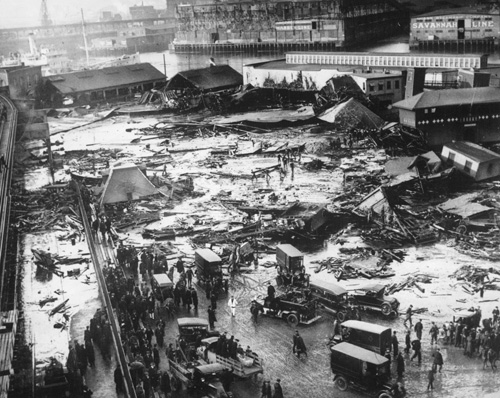
Exactly four centuries after Balboa's execution, a 50-foot tall vat of molasses collapsed in the North End of Boston, sending a tidal wave of syrup into the streets. More than two million gallons of dark brown sweetness rushed forth at 35 miles per hour, carrying a force of 2 tons per square foot. The Boston Post, mixing several culinary metaphors, described the horrific scene the next day:
Like eggshells it crushed the buildings of the North End yard of the city's paving division… To the north it swirled and wiped out practically all of Boston's only electric freight terminal. Big steel trolley freight cars were crushed as if eggshells, and their piled-up cargo of boxes and merchandise minced like so much sandwich meat.
In the wave of molasses and the vacuum created in its wake, a section of Boston's elevated train track was destroyed and a train car thrown into the air; several buildings were wrecked. A firefighter named George Leahy was trapped underneath the firehouse -- although he managed to keep his head above the molasses for several hourse, he eventually lost consciousness and drowned. In the end 21 people perished, crushed or asphyxiated by the most common form of sweetener in the United States at the time. Several of the bodies were too battered and glazed to be properly identified. Nearly 200 other Bostonians were injured in the catastrophe. Of the 20 horses who died in the molasses wave, several had to be shot because they could not be extracted from the goo.

United States Industrial Alcohol, the company that owned the faulty vat, tried to blame the accident on anarchist saboteurs but eventually settled lawsuits totaling more than $600,000.

Labels: , ,

|

Tuesday, January 08, 2008

January 8


Seven years after the United States acquired the massive Louisiana territory from France, the population of New Orleans consisted of more than 18,000 enslaved and free people of color who lived in subjection to the 8000 whites who also lived within the city walls. Louisiana was a horrific place for enslaved people, who died nearly as fast as they could be replaced, worn down by the building of levees, the clearing of fields, and the tending of sugar cane. Moreover, New Orleans hosted the most abominable slave market in North America.

Inspired by Haiti's recent successes against the Napoleonic armies, the slaves who lived in southern Louisiana's rural parishes hoped that a sudden insurrection -- assisted by the black majority of New Orleans -- might wrest control of the city away from its white minority. Like all slave uprisings in North America, previous ventures along these lines -- most recently in 1795 in Pointe Coupe -- had been brutally crushed and the conspirators executed swiftly. However, with US forces preoccupied with the Spanish in Florida at the time, the winter of 1811 seemed a more auspicious moment than most to revive the dream of a tiny black republic at the mouth of the Mississippi River.

After concocting their plot in the swamplands near Maupe, the rough militia embarked from the Aubry plantation, nearly 40 miles from the city, late in the afternoon of January 8. They were led by a man named Charles Deslondes, who organized the army into neat formations and marched them with flags aloft. As their ranks swelled to more than 500 men armed with small arms and farm tools, the rebels arrived the next morning at the home of Jean Francois Trepagnier, six miles away. There, one of Trepagnier's slaves -- a young man named Gustav who had escaped shortly after his 21st birthday -- hacked his former master to death.

As word of the revolt spread throughout the sugar plantations, whites raised a militia of their own and were quickly assisted by US troops from Baton Rouge as well as the Free Black Militia of New Orleans, whose offers to help quell the insurgency were accepted. The enslaved rebels failed to reach the city arsenal, leaving them at the mercy of the much more capably armed free soldiers, who slaughtered them with canon fire at the Fortier Sugar Works, 18 miles from their' destination. Those who were not killed in battle were quickly tried and executed by hanging or firing squad at Saint Louis Cathedral. In the customary fashion, the heads of the slaves were cut off and placed along major roads as a warning to others. Samuel Hambleton, a naval agent stationed in New Orleans, wrote to a friend and described the trophies as looking "like crows sitting on long poles." As for Charles himself, his hands were cut off and was shot in both legs and the torso; before he died, he was rolled into a bundle of straw and "roasted" alive.

Later, the Trepagnier plantation was renamed "Diamond." Today Diamond remains a predominantly black community, where descendants of slaves reside nearly 200 years after their ancestors witnessed the largest revolt in North American history.

By the end of the 20th century, Diamond had become a toxic swamp, as pollutants from incinerators, petrochemical and cement plants left the town's poorest residents suffering from chronic health problems.

Labels: , ,

|

Friday, December 07, 2007

December 7

Ney2
Michel Ney, a marshall in the Napoleonic army, was shot by a firing squad of his own countrymen on this date in 1815, just hours after the sentence was delivered by the overwhelming assent of the Chamber of Peers. Ney, one of Napoleon's most trusted and revered subordinates, was convicted of treason for abandoning the regime of Louis XVIII for the usurper Napoleon, who had returned from his exile in Elba to regain the imperial throne he had abdicated the year before. Nicknamed le brave des braves by the Emperor during happier times, Ney was widely (and somewhat unjustly) blamed for the Belgian catastrophe at Waterloo in June 1815. The defeat of Napoleon bode poorly Ney's fate, which the Parisian royalists were determined to seal with an execution. In a letter written shortly after the battle, the marshall explained to a friend that:
[t]he most false and defamatory reports have been publicly circulated for some days, respecting the conduct which I have pursued during this short and unfortunate campaign. The journals have repeated these odious calumnies, and appear to lend them credit. After having fought during twenty-five years for my country, and having shed my blood for its glory and independence, an attempt is made to accuse me of treason; and maliciously to mark me out to the people, and the army itself, as the author of the disaster it has just experienced.
Ney would repeat those sentiments to an unmoved Chamber during his trial. Only one Peer voted for Ney's acquittal.

At an isolated spot in the Jardin du Luxembourg, Ney was offered a blindfold -- which he refused -- and was given the privilege of ordering his own death. According to some witnesses, Ney's final words underscored his reputation for bravery. "Soldiers," he instructed, "when I give the command to fire, fire straight at my heart. Wait for the order. It will be my last to you. I protest against my condemnation. I have fought a hundred battles for France, and not one against her . . . Soldiers Fire!"

***

texas7At 12:07 a.m. on 7 December 1982, the state of Texas executed Charles Brooks, Jr., for the crime of killing a used car mechanic six years previous. For no discernible reason, David Gregory was abducted by Brooks and Woody Loudres and taken to a motel, where he was bound to a chair and shot by by either Brooks or his accomplice, neither of whom ever explained who actually fired the shot. Loudres pled guilty to a lesser crime and received 40 years in prison; Brooks, who protested his innocence and fought the capital charge, was sentenced to death by lethal injection. He would be the first American to die by this newer, more palatable means of execution; he would also be the first African-American executed in the US since 1967.

After exhausting his appeals, Brooks was strapped to a gurney at the state prison in Huntsville, Texas. With eighteen witnesses viewing the scene behind plexiglass, Warden Jack Pursley permitted Brooks to speak some final words, which he spent on a prayer to Allah and a brief word of encouragement to his girlfriend Vanessa Sapp, whom he urged to "stay strong." When Warden Pursley gave the signal, a stream of poisons were released into Brooks' arm. He yawned, raised his arm, then wheezed as a dose of sodium thiopentol slipped him into unconsciousness. By all appearances asleep, Brooks was then administered roughly 100 milligrams of pancurinium bromide, which would have caused total muscular paralysis, masking what was quite likely excruciating pain as his diaphragm collapsed and he began to asphyxiate. Finally, the execution was completed with a dose of potassium chloride, which brought on a massive heart attack.

Labels:

|

Saturday, November 03, 2007

November 3

olympe de gougeThe revolutionary French essayist and playwright Marie Olympe de Gouges was executed by guillotine two hundred and three years ago today. An abolitionist and advocate for women's equality in public as well as in all matters of love and marriage, de Gouges went so far as to insist that married women had the right to divorce their husbands and have affairs with other men -- and that the children of such illicit unions be regarded without legal discimination or public scorn. Equally scandalous were her beliefs that women "must be equally admitted to all honors, positions, and public employment according to their capacity and without other distinctions besides those of their virtues and talents." In works such as the Contrat Social and Déclaration des droits de la Femme et de la Citoyenne, de Gouges challenged not merely the traditional conventions of French society, but ran afoul as well of the morality of the Jacobins, who had begun severing the heads of their political opponents a few months before. Courting danger, de Gouges criticized the execution of Louis XVI in January 1793.

Accused of "having composed a work contrary to the expressed desire of the entire nation," de Gouges was arrested and tried on 12 Brumaire (2 November), Year II of the Republic. Her writings were introduced as evidence that de Gouges had violated Article I of the laws of March 29, which ruled that "whoever is convicted of having composed or printed works or writings which provoke the dissolution of the national representation, the reestablishment of royalty, or of any other power attacking the sovereignty of the people, will be brought before the Revolutionary Tribunal and punished by death." Throughout the trial, according to the official court record, "the accused, with respect to the facts she was hearing articulated against her, never stopped her smirking. Sometimes she shrugged her shoulders; then she clasped her hands and raised her eyes towards the ceiling of the room; then, suddenly, she moved on to an expressive gesture, showing astonishment; then gazing next at the court, she smiled at the spectators, etc." The verdict of the court affirmed the charges against her.

Around 4:00 p.m. the following day, Marie Olympe de Gouges was led to the scaffold. After crying out for the assembled crowd to avenge her death, de Gouges' head was lopped off into a basket.

Reporting on her execution in the place de la Revolution, one source judged that "Olympe de Gouges, born with an exalted imagination, mistook her delirium for an inspiration of nature. She wanted to be a man of state. She took up the projects of the perfidious people who want to divide France. It seems the law has punished this conspirator for having forgotten the virtues that belong to her sex."

More than 250 150 years later, on November 3, 1954, Godzilla -- awakened by a nuclear test arose from the sea and destroyed Tokyo.

Labels:

|

Wednesday, September 19, 2007

September 19

GilecoryDetermined to extract a confession of witchcraft from Giles Corey, the magistrates of Salem, Massachusetts turned to an "alternate set of procedures" -- to use a more contemporary phrase -- when the 80-year-old farmer held his tongue, vowing neither to deny nor to confirm the charges that had been leveled against him five months previous, in mid-April 1692.

On September 17, one man and eight women -- including Corey's third wife Martha -- had been condemned to die for colluding with the devil. Among other absurdities, Martha Corey was accused of "having familiarity with the Devil . . in the shape of a black man whispering in her ear" and of "afflicting" several young girls of Salem with bite marks and scratches, each of which the girls helpfully displayed to the assembled magistrates during the trial. Giles Corey, recognizing the accusations as a community hallucination, refused to join his wife in attempting to refute the charges against them.

By virtue of English common law, Corey could not be tried unless he entered a formal plea before a judge; by virtue of that same common law, a defendant who "stood mute" in this fashion could be subjected to peine forte et dure -- a "long and forceful punishment" that involved heavy weights being pressed upon the accused until he or she at last surrendered a plea. Three hundred and fourteen years ago today, Giles Corey was stripped and placed between two boards, after which heavy rocks were gradually placed atop Corey's feeble body. As the eyewitness Robert Calef recorded in More Wonders of the Invisible World (1700), "In pressing[,] [Corey's] tongue being forced out of his mouth, the Sheriff with his Cane forced it in again, when he was dying. He was the first in New England that was ever prest to death."

According to legend, Corey's last words consisted of a simple request for "more weight."

Labels: ,

|

Thursday, September 06, 2007

September 6

According to a long-time White House doorman named Theodore Pendel, William McKinley enjoyed a good handshake. In his 1902 memoir, Pendel explained that
[t]he President always took great delight in shaking hands with the people. He told one of the officials at the White House that he took more delight in shaking hands with the people than he did at one of the state dinners. It seemed to be a great gratification to him to meet the masses of the people.
Shortly after 4:00 p.m. on September 6, 1901, an anarchist named Leon Czolgosz shot McKinley in the chest and stomach while the president was presumably having the time of his life, shaking hands with his adoring public at the Pan-American Exposition in Buffalo, New York.

Although it initially appeared that McKinley might survive his wounds, he eventually succumbed to pancreatic necrosis after eight lingering days. At his funeral, Rev. Morgan Dix -- son of former New York governor John Dix -- hyperbolized about the third presidential assassination in four decades. Calling attention to the perils of anarchism, Dix asked
will the nation fail to act as a great nation should, to deal as it ought to do with the most deadly foe that it has or ever can have? For if this foe prevails, the nation, the state, the law, the government will disappear forever and ever. Are we to forget what has thrown us into this present mourning and these tears? Are we to lapse into a fatal apathy, and let the preaching of murder and inciting to murder and the applauding of murder go on as before? Are the laws still to protect the very persons who hate and detest them and are banded together for the overthrow of society? It seems to me that the most solemn issue of the hour is as to what we have to do who remain—whether we are equal to the occasion. Are we now to fall back before this enemy, the last and most dangerous we have ever encountered or ever shall, and let things drift from bad to worse, in new instances of a passion which spares not one life that stands in its way?
Czolgosz, who was nearly beaten to death by infuriated bystanders after the shooting, was taken into custody and quickly tried for McKinley’s murder; to no one’s surprise, he earned a guilty verdict and a sentence of death, which was carried out on October 29, six weeks after McKinley's demise. At his electrocution, Czolgosz expressed no regrets and issued no apologies for the assassination.

"I killed the President," he said, "because he was the enemy of the good people, the good working people. I am not sorry for my crime."

Labels: ,

|

Monday, September 03, 2007

September 3

Three years ago today, Paul Jennings Hill sat down to a hearty meal of steak with Hollandaise sauce, baked potato, broccoli, salad, and a jug of sweetened iced tea. For dessert -- which he ate minutes before the state of Florida executed him by lethal injection -- Hill enjoyed a frosty bowl of orange sherbet.

By the accounts of his supporters, the condemned would have found his last meal especially satisfying. Far from dreading his encounter with what Justice Harry Blackmun famously called “the machinery of death,” Paul Jennings Hill expected that his execution would lead him onward toward a fantastic “reward” in Heaven. Hill’s martyrdom, his unhinged mind told him, was earned for turning a Mossberg 12-gauge shotgun on John Britton -- a Pensacola doctor who offered abortion services -- and his guard, James Barrett, in the parking lot of the Ladies Center on 29 July 1994. Britton, struck with four close-range blasts to the face and upper chest, was the second doctor to be shot at the clinic by assassins who believed themselves to be on a holy mission to protect the unborn. In March of the previous year, Michael Griffin emptied a .38 caliber handgun into the back of Dr. David Gunn.

Less than a week after the shooting, the previously unknown Paul Jennings Hill appeared on Donahue to defend Griffin, his mouth expelling plume of righteous froth as he casually likened Dr. Gunn to Josef Mengele. The following month, Hill appeared on Nightline to endorse the good works of Rachelle “Shelley” Shannon, a serial arsonist and housewife who shot and wounded Dr. George Tiller at a clinic in Wichita, Kansas. A little over a year later, this self-described “slow learner” had followed up his words with deeds, affirming his own place in the hierarchy of violent zealots by receiving the first death sentence in American history handed down for the murder of an abortion provider.

Rev. Don Spitz of the Army of God -- a group that promotes to use of violence to thwart abortion -- befriended Hill during his years in prison. “He's totally ready," Spitz observed a week before the execution. “He's 100 percent willing. He's ready to give his life for the babies." On September 3, Spitz watched Hill die and later recorded the following stream of neo-medieval superstition:
Around 5:45 PM a large rainbow appeared over Florida State Prison, then around 6 PM a great storm arose and the sky turned black. I remarked to Paul's lawyer that this is like when Jesus was crucified. While I was in the observation room, the lights flickered a couple of times; this happened right before Paul spoke his 'last words'. I wondered if I would be sitting in the dark and started thinking whether the prison had back up generators; and if so, would they go ahead with the execution. From reports outside, both from media and Paul's friends, some long bolts of lightning happened around 6 PM, so close that smell from it was obvious. Another appeared to hit close to the prison itself. A few minutes after 6, the storm ended as suddenly as it started and then began a gentle rain. I personally do not think this was coincidence.
Precisely two years later, in what Spitz no doubt regarded as yet another moment of non-coincidence, Chief Justice William Rehnquist succumbed to thyroid cancer. Rehnquist -- who cast one of two dissenting votes in Roe -- was regarded by Spitz and other radicals as insufficiently supportive of their project. Most notoriously, Rehnquist voted with the majority in several cases in 1996 and 1997 that upheld “buffer zones” around family planning clinics, zones designed in part to prevent the kinds of attacks advised by the Army of God. Rehnquist’s death, to Spitz’ delight, cleared a path on the high court for the nomination of Samuel Alito.

This is a re-post of last year's entry

Labels: ,

|

Wednesday, August 29, 2007

August 30

Two hundred and seven years ago, an enslaved blacksmith named Gabriel launched a conspiracy that -- had it not been foiled by weather and betrayal -- would have amounted to the largest slave rebellion in American history. Gabriel "Prosser," as he was known, believed himself to be a liberator of the oppressed; as such, his readings of the Bible convinced him that God would favor his efforts to lead an army of his fellow bondsmen against the city of Richmond, Virginia. With the help of a small group of co-consirators, Gabriel devoted months during the summer of 1800 to gathering comrades and weapons. They devised a plan to capture Virginia's governor, James Monroe, and use him as leverage to sever the state from the union and proclaim an independent, slavery-free republic with Gabriel himself as ruler.

The plan collapsed in spectacular fashion on August 30, the night chosen for the uprising, when torrential rains washed out key bridges and roads. As rumors of a slave insurrection caused eastern Virginia's white population to cower in their homes, the lure of financial reward drew several of Gabriel's army into the eager embrace of local militias. The plot foiled, Gabriel and the leaders of the rebellion scattered into the countryside, where they were hunted and captured over the next several weeks. Gabriel himself was delivered to authorities in mid-September after taking refuge aboard a schooner owned by a former slave overseer who -- having since altered his views of the peculiar institution -- agreed to take Gabriel to freedom. Unfortunately for the rebel leader, he was betrayed in Norfolk by a fellow slave named Billy, who -- believing he would earn $300 for his troubles -- ultimately received a mere $50 for the information that led to Gabriel's capture.

After a brief trial, Gabriel dangled from the gallows on October 10, 1800. All told, nearly three dozen slaves lost their lives in the aftermath of the failed revolt. The commonwealth of Virginia spent about $9000 compensating the owners of the dead.

Labels: , ,

|

August 29

Francisco de Xeres, secretary to the illiterate conquistador Francisco Pizarro, chronicled an execution that took place in the summer of 1533. The victim was a man named Atahualpa, who was at the time the sovereign ruler of the Incan Empire. Pizarro had taken Atahualpa hostage the previous November after her rejected the Spaniard's demand that he submit to Christianity. By showing his disdain for the so-called requerimiento, Atahualpa had unwittingly violated Spanish law, which he quite reasonably believed did not apply to his own people. After months of captivity, during which time Pizarro and his 168 soldiers extracted staggering ransom from Atahualpa's subjects, the last sovereign Inca was convicted on utterly implausible charges of murder and treason and sentenced to death.

As de Xeres explained, Atahualpa's sentence -- to be burnt alive -- might be altered if he converted.
They brought out Atahualpa to execution; and, when he came into the square, he said he would become a Christian. The Governor was informed, and ordered him to be baptized. The ceremony was performed by the very reverend Father Friar Vicente de Valverde. The Governor then ordered that he should not be burned, but that he should be fastened to a pole in the open space and strangled. This was done, and the body was left until the morning of the next day, when the monks, and the Governor with the other Spaniards, conveyed it into the church, where it was interred with much solemnity, and with all the honors that could be shown it. Such was the end of this man, who had been so cruel. He died with great fortitude, and without showing any feeling . . .
He also died, in the eyes of the Spanish, as "Juan de Atahualpa" -- the Christian name he enjoyed for the last few moments of his life.

Although Atahualpa was most likely garotted in late July 1533, his death has frequently -- and more poetically -- been assigned to August 29, which happens to be the Catholic feast day in honor of John the Baptist.

Meantime, perhaps 90-95 percent of the Incan Empire succumbed to smallpox, a horrific disease to which the Spanish were immune.

Last year's entry: the Rais Massacre

Labels: ,

|

Thursday, August 23, 2007

August 23

Eighty years ago today, Nicola Sacco and Bartolomeo Vanzetti were executed at Charlestown State Prison in Massachusetts for the murder of two shoe factory employees seven years before. The murders took place in the midst of the post-World War I “red scare,” and the arrest of two Italian anarchists -- a class considered by many Americans as the gravest threat to the nation -- surprised no one. Although physical evidence connecting the men to the crime was either ambiguous or nonexistent, a circumstantial case persuaded a jury of their guilt; Judge Webster Thayer, who presided over the original trial, had set the tone for the proceedings by equating jury duty with military service.
The Commonwealth of Massachusetts called upon you to render a most important service. Although you knew that such service would be arduous, painful and tiresome, yet you, like the true soldier, responded to that call in the spirit of supreme American loyalty. There is no better word in the English language than “loyalty.”
Thayer, who once berated a jury for acquitting an Italian anarchist, could not have been more clear about what might qualify as a “loyal” verdict.

Over the next six years, the case of Sacco and Vanzetti drew the world’s attention. As the execution date neared, workers in the United States and Europe protested vigorously. On August 7, 1927 hundreds of thousands of American workers threw down their tools and walked off their jobs. Appeals for clemency and motions for new trials had come to naught. The governor of Massachusetts appointed a commission to assess the fairness of the trial, though its conclusions were all but preordained. The United States Supreme Court declined to intervene.

As for the condemned themselves, they spent the last months of their lives writing letters to family, friends and supporters. In one of the most memorable of these, Nicola Sacco wrote to his daughter Ines:
I would like that you should understand what I am going to say to you, and I wish I could write you so plain, for I long so much to have you hear all the heart-beat, eagemess of your father, for I love you so much as you are the dearest little beloved one.

It is quite hard indeed to make you understand in your young age, but I am going to try from the bottom of my heart to make you understand how dear you are to your father's soul. If I cannot succeed in doing that, I know that you will save this letter and read it over in future years to come and you will see and feel the same heart-beat [of] affection as your father feels in writing it to you.

Labels: ,

|

Tuesday, August 14, 2007

August 14

Today is the 71st anniversary of the last public execution in the United States. On 14 August 1936, Rainey Bethea was hanged by the neck before a crowd of 20,000 gawkers in Owensboro, Kentucky. The 22-year-old Bethea had been convicted earlier that summer in the drunken murder of 70-year-old Lischia Edwards, whom he had raped and strangled in her own bedroom on June 7.

At 5:32 a.m. on August 14, Bethea ascended the scaffold wearing a clean pair of socks. He had not eaten breakfast, but was likely still full from the fried chicken, pork chops, mashed potatoes, cornbread, pickles, lemon pie and ice cream he had requested for his last meal more than 12 hours earlier. Spectators had begun arriving in the middle of the night and jostled for position as Rainey’s head was draped in a black hood and his arms and legs bound with leather straps. The executioner, who was more than a little drunk, had to be told more than once to pull the lever and end the life of Rainey Bethea.

Fourteen minutes after his neck snapped at the end of an eight-foot rope, Bethea was officially declared dead. His body was dumped into a pauper’s grave in Owensboro. Press coverage of the execution was almost unanimously critical, as reporters described -- and embellished -- scenes of unflattering public enthusiasm. A headline in the Philadelphia Record announced that “[The crowd] Ate Hot Dogs While a Man Died on the Gallows.” In the Louisville Courier-Journal described a crowd that cheered with delight when Bethea’s neck snapped/
Souvenir hunters ripped the hangman's hood from Bethea's face immediately after his body dropped. Bethea still breathed when a few persons from the crowd rushed the four-foot wire inclosure [sic] about the scaffold and scrambled for fragments as mementoes.

People stood on roofs, hung from telephone poles, leaned out windows, stood on automobiles. One group took possession of the roof of a hearse waiting for Bethea's body. Many children, including babies were carried on the shoulders of their parents. It ought to be a lesson to them.

The condemned man ‘appeared to be serious but calm.' Naturally, he didn't enter in the spirit of gaiety. He couldn't look forward to entertaining his friends with a recital of the adventure and boring them thereafter with it for the remainder of his days. It was a serious event in Bethea's life. It was a serious event in the life of Kentucky, too, as the morbid enjoyment of that curious throng attests.
As it happened, Bethea took at least one other person with him. About an hour before the execution, a man named Leonard Peters -- rushing with his wife and another couple from Evanston to Owensboro -- was killed in an accident when he drove his vehicle into a ditch. Peters’ wife and friends survived, though one presumes they did not make it to Owensboro in time for the hanging.

Labels:

|

Monday, August 06, 2007

August 6

William Kimmler, a vegetable salesman from Buffalo, hacked his wife to death with an axe, a crime for which he became the first person to die in the electric chair. The execution, which took place at Auburn Prison on August 6, 1890, turned out to be a horrific spectacle lasting much longer than anyone had predicted. Kimmler himself assumed his death would be -- as advocates for the method like Thomas Edison assured -- humane and instantaneous. Edison and others had had electrocuted dozens of dogs and cats using various contraptions. Prison officials had tested the chair on a horse on August 5, and everything seemed to go well.

Less could be said for the actual execution the next day, as the initial 17-second application of current, did not snuff out Kimmler’s life. Albert Southwick, the dentist who first proposed the notion of an electric chair in 1881, was on hand for the historic event and expressed premature elation after the first surge. “There is the culmination of ten years work and study!” he ejaculated. “We live in a higher civilization from this day.” When doctors discovered that Kimmler was still breathing, they quickly ordered an additional four-minute surge of 2000 volts, the effect of which was to bake the man literally to a crisp, as his skin caught fire and smoke poured from his head.

The New York Herald filed a dramatic report on the incident:
The killing of Kemmler to-day marks, I fear, the beginning and the end of electrocution, and it wreathes in shame the ages of the great Empire State who, entrusted with the terrific responsibility of killing a man as a man was never killed before, brought to the task imperfect machinery and turned and execution into a horror . . . .

Man accustomed to every form of suffering grew faint as the awful spectacle was unfolded before their eyes. Those who stood the sight were filled with awe as they saw the effects of this most potent of fluids which is only partly understood by those who have studied it most faithfully, as it slowly, to slowly, disintegrated the fibre and tissues of the body through which it passed.

The heaving of a chest which it had been promised would be stilled in an instant peace as soon as the circuit was completed, the foaming of the mouth, the bloody sweat, the writhing shoulders and all the other signs of life.

Horrible as these were they were made infinitely more horrible by the premature removal of the electrodes and the subsequent replacing of them for not seconds but minutes, until the room was filled with the odor of burning flesh and strong man fainted and felt like logs upon the floor.

And all this done in the name of science.
Fifty-five years later, another deadly scientific advance was used for the first time. On August 6, 1945, “Little Boy” was dropped from the belly of a B-29 named the Enola Gay. The 4000 kilogram bomb -- 64 kilograms of which was enriched uranium from the Belgian Congo -- sailed quietly through the sky for 57 seconds before obliterating the Japanese city of Hiroshima and at least 70,000 people who lived and worked there. Tens of thousands more would later die from burns, radiation poisoning, and cancers of numerous and unpleasant kinds.

Labels: , ,

|