Monday, January 21, 2008

January 21

Today is the Feast of St. Agnes, when Roman Catholics honor the most important of the virgin martyrs. According to legend, Agnes of Rome, a young Christian girl twelve or thirteen years of age, was executed on this date sometime in the third or fourth century anno domini. Agnes' transgression, evidently, was to refuse an offer of marriage from the son of a Roman prefect; when she refused, the prefect ordered her to be raped, tortured and burnt at the stake. In one account by the fourth-century Roman Catholic poet and hymnist Aurelius Prudentius Clemens, one of her would-be violators was stricken blind and comatose when he cast a lewd eye upon her. Thus, while her virginity was spared, Agnes' life was not. At her execution, the wood surrounding her body failed to ignite. According to the fourth-century account by St. Ambrose -- included in his three-part meditation de virginis ("Concerning Virgins") -- Agnes greeted her death without hesitation:
She stood, she prayed, she bent down her neck. You could see the executioner tremble, as though he himself had been condemned, and his right hand shake, his face grow pale, as he feared the peril of another, while the maiden feared not for her own. You have then in one victim a twofold martyrdom, of modesty and of religion. She both remained a virgin and she obtained martyrdom.
Although the conventional accounts of her execution are ghastly, little is actually known of Agnes' life aside from its brevity. Traditionally, her execution was believed to have occurred during the Diocletian persecutions, sometime around the year 304 or 305; other evidence, however, suggests that her martyrdom may have occurred some years before during the reign of Gaius Decius, a half century or more prior to Diocletian. Regardless of her date of death, Agnes came to be known as the patron saint of young girls. He body was placed in sepulchre, and during the reign of Constantine St. Agnes was honored with a basilica constructed around her final resting place. She remains there to this day.

***
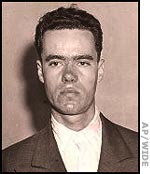
A man of considerably less sanctity than Agnes, Howard Unruh, turns 87 today in the Trenton Psychiatric Hospital. He has been there since 1949, when the unemployed World War II tank soldier shot up his pleasant Camden, New Jersey neighborhood on September 6 of that year. Unruh believed his neighbors were talking about him behind his back, and he soon began to compile a hit list of local enemies. When someone stole a new gate he had installed at his mother's house -- where he still lived -- Unruh at last snapped and decided to shoot everyone on his roster. He carried out his plan the next morning after a breakfast of fried eggs, although he did not exactly stick to the list. In twelve minutes, he managed to shoot 26 people, half of whom died. And so it was that Howard Unruh became the first single-episode mass murderer in United States history.

"I'm no psycho," he told an investigator. "I have a good mind. I'd have killed a thousand if I had bullets enough."

Labels: ,

|

Tuesday, December 04, 2007

December 4

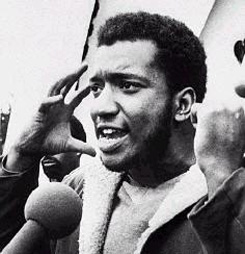
Just before 5:00 a.m. on this date in 1969, more than a dozen Chicago police officers stormed a house on the city’s west side; among their targets was a young community activist and Black Panther Party member named Fred Hampton, whom one of the officers proceeded to kill with a pair of point-blank shots to the back of his head.

During the years leading up to his death, Hampton had migrated from the NAACP -- through which he worked as a youth organizer -- to the Black Panthers, a revolutionary Marxist party whose Illinois chapter Hampton helped found. Although Hampton, like most members of the BPP, believed in the inevitability of socialist revolution, he spent most of his time developing social welfare programs like the Breakfast For Children, which offered free meals to kids in Chicago’s poorest neighborhoods. And while the Panthers prepared for the international proletarian struggle by arming themselves, they did so while living within the realm of Mayor Richard J. Daley, a genuine thug whose police enforced an Alabama-style racial apartheid.

Not surprisingly, relations between the city’s police and black community were less than warm. Skirmishes between the CPD and the Black Panthers -- most of them provoked by the former -- had become routine during the second half of 1969; with the encouragement of the FBI, which regarded the Black Panthers as a grave domestic threat, the Chicago police sought to completely uproot the organization. Hampton, who quite probably had been drugged the night before his death by an FBI informant named William O’Neill, did not wake up when the special operations unit burst in to the apartment, nor did he stir when his friend and fellow Panther Mark Clark was shot and killed in the living room. Even several bullet wounds to the shoulder -- all fired by the Chicago police -- were insufficient to get Fred Hampton out of bed.

The Chicago police initially claimed that Hampton had been killed in the confusion caused by an intense, 10-minute gun battle between the police and the handful of black revolutionaries sleeping in Hampton’s apartment. As it turned out, only a single shotgun blast -- fired from Mark Clark’s gun as he died -- came from any of the Panthers or their friends. No one was ever charged in the killing of Hampton, though civil suits brought by the families of Hampton and Clark were eventually settled out of court.

Hampton, one of the most gifted community organizers of his generation, was only 21 when he died. Aside from the false claim that a sleeping Hampton and his colleagues had initiated a gun battle, no specific reasons were ever cited for the raid.

Labels: , ,

|

Sunday, December 02, 2007

December 2

elsal4Twenty-seven years ago today, four American women were murdered in El Salvador by officers of that country's National Guard -- victims in a civil war that would eventually claim over 70,000 lives. On the evening of December 2, Maryknoll Sisters Ita Ford and Maura Clarke, lay missioner Jean Donovan and Ursuline Sister Dorothy Kazell were abducted near the San Salvador airport when Ford and Clarke returned from a Maryknoll conference in Managua, Nicaragua. Along with four other guardsmen in civilian clothing, Sergeant Luis Antonio Colindres Aleman followed the women in a military jeep and detained them. After interrogating the four women, Aleman ordered that the Americans be taken to a remote field about 15 miles from the airport, where they were to be "eliminated" on the instructions of his superior officer. Each was raped and shot in the head by men trained and armed by the United States. The bodies were dumped along the side of the road. The next morning, when the bodies were discovered, a local justice of the peace ordered that they be buried in shallow graves. On December 4, the four women were exhumed after Ambassador Robert White learned of the murders.

Catholic priests, nuns, and lay workers were frequently accused by the right-wing Salvadoran government of aiding communist guerillas during the decade-long civil war; religious workers -- particularly those from outside El Salvador -- were routinely arrested, harrassed, beaten and tortured for providing food, medical aid and other forms of relief to the tens of thousands of people displaced by the violence. Jean Donovan, one of the December 2 victims, frequently picked up bodies of peasants left by death squads on the roadsides near La Libertad, the village where she worked. Donovan and her colleagues understood that their lives were at risk each day they remained in El Salvador. During a liturgy held in Managua the night before she was killed, Ira Ford read a passage from one of Archbishop Oscar Romero's last homilies, delivered shortly before he was assassinated in March 1980:
Christ invites us not to fear persecution because, believe me, brothers and sisters, the one who is committed to the poor must run the same fate as the poor, and in El Salvador we know what the fate of the poor signifies: to disappear, be tortured, to be held captive -- and to be found dead
Under Jimmy Carter and Ronald Reagan, the United States provided material assistance and training to the Slavadoran military that killed Ford, Clarke, Donovan and Kazel. Two months after the deaths of the churchwomen, Secretary of State Alexander Haig urged Ambassador White to publicly congratulate the government of El Salvador for conducting a thorough and prompt investigation of the muders; Haig was hoping to put the matter to rest so that full military assistance to the Salvadoran military could be resumed.

Because the regime of Jose Napoleon Duarte was not in fact conducting such an investigation, however, White refused Haig's request. He soon became the first ambassador to be fired during the Reagan administration.

Labels: ,

|

Tuesday, November 20, 2007

November 20

Edmund the Martyr, King of East Anglia, was killed by Danish invaders -- forces of the Great Heathen Army -- on this date in the year 869. Led by Ivar the Boneless and Hubba Ragnarson, the Danes captured Edmund in battle; before killing him the, they insisted Edmund renounce his Catholic faith, which -- as a proper candidate for martyrdom -- he did not do. Accoring to Edmund’s earliest biographer, events quickly took a turn for the worse:
Then those wicked men bound Edmund and shamefully insulted him and beat him with clubs, and afterwards they led the faithful king to an earth–fast tree and tied him to it with hard bonds, and afterwards scourged him a long while with whips, and among the blows he was always calling the true faith of Jesus Christ. Then the heathen were madly angry because of his faith, because he called upon Christ to help him.

They shot at him with javelins as if for their amusement, until he was all beset with their shots, as with a porcupine's bristles, even as Sebastian was. When Hingwar, the wicked seaman, saw that the noble king would not deny Christ, but with steadfast faith ever called upon Him, he commanded men to behead him, and the heathen did so. For while he was yet calling upon Christ, the heathen drew away the saint to slay him, and struck off his head with a single blow, and his soul departed joyfully to Christ.
More than 800 years later, in 1695, Zumbi -- the great Afro-Brazilian folk hero -- was captured and beheaded by Portugese forces, bringing a conclusion to nearly 70 years of resistance from the maroon community of Palmares.

Located in an inaccessible region of Northeastern Brazil, tucked behind the mountains that divided the coastal settlements from the continental interior, Palmares had drawn tens of thousands of fugitive Angolans during the 17th century. Enslaved by the Portugese, the Angolans fled the sugar plantations and established one of the largest maroon settlements in the Western hemisphere. With as many as 30,000 inhabitants by 1650, Palmares was able to withstand Portugese conquest for decades. Zumbi, born in 1655, grew up to be the fugitive kingdom’s most renowned military leaders.

For fifteen years beginning around 1680, Zumbi and his forces bedeviled the Portugese. In November 1695, however, his fortune came to an end when he was betrayed by a fellow fighter and taken captive by the Portugese, who beheaded him on the spot.

Lofting his head to the coastal town of Recife, the Portugese displayed it in the central plaza as proof of Zumbi's mortality.

Labels:

|

Wednesday, November 07, 2007

November 7


Although Illinois was technically a “free state” in the late 1830s, slavery continued to exist within its borders until 1845, when the state’s supreme court issued a ruling that effectively ended the “peculiar institution” for good. Nevertheless, like most northern states, Illinois maintained a ferocious commitment to white supremacy in both law and fact. Free blacks were denied the right to vote, hold office or serve in the militia, and they were obligated register their certificates of freedom with the state. After 1829, they were required to post $1000 bond before settling in a state that would eventually be known as the “Land of Lincoln.” In 1822, advocates for human bondage managed to secure a popular referendum on the question of rewriting the state constitution to fully legalize slavery. The measure lost, though it attracted more than 40 percent of the vote.

Most white citizens of Illinois -- even those who opposed slavery -- loathed blacks and wished them gone in one way or another. Thus, “colonization” societies sprouted throughout the state, encouraging the US to cleanse itself by transporting African descendants back from whence they had involuntarily come. Genuine abolitionists like Elijiah Lovejoy, the Maine-born editor of the Alton Observer, were hardly welcome; much of white Illinois wished people like him gone as well, and in November 1837 they received their wish. On November 7, several months of escalating confrontation in Alton resulted in Lovejoy’s murder at the hands of a white lynching party, who laid siege to his office, smashed his printing press -- the fourth one to receive such treatment since his arrival in Alton the previous year -- and filled his torso with bullets. Crying “Oh God, I am shot,” Lovejoy died within minutes.

He was buried on what would have been his 35th birthday, November 9, 1837. His wife Celia -- six months pregnant with their second child -- was too distraught to attend the funeral.

While abolitionists across the nation quickly praised Lovejoy as a martyr to the antislavery cause as well as to the principle of a free press, he was predictably cast as a villain throughout the Midwest and the South. The Missouri Republican, commenting on the episode shortly after the killing, condemned “mob violence” while placing the blame for Lovejoy’s death on his own actions:
[W]hen we see a man recklessly, wantonly, and mischievously persist in a course which others are sure to regard as an outrage on their feelings, which is sure to inflame the popular mind and lead to violence, we have but little sympathy for his sufferings. He who willfully excites the tempest should be the first to feel its violence.
More than twenty members of the mob were tried for the destruction of the press and the murder of Elijah Lovejoy. All were acquitted.

Labels: , ,

|

Wednesday, October 31, 2007

October 31


Nearly 470 years ago today, an Anabaptist minister named Offrus Greizinger was martyred after refusing to cast aside his faith, which both Catholics and most Protestants alike regarded as heretical. Anabaptists -- forbears of the Hutterite, Amish and Mennonite communities among others -- rejected infant baptism and practiced “non-resistance,” as evidenced by the hundreds of believers who were tortured and killed by various authorities over the course of the 16th and 17th centuries.

Greizinger’s tale was among those collected by the Dutch Anabaptist Tieleman Jansz van Braght, who published The Bloody Theater or Martry’s Mirror in 1660. A minister in the Earldom of Tyrol, Greizinger ran afoul of the local Catholic authorities who -- by posing as seekers of the faith -- managed to capture and transport him to the Italian city of Brixen. There, he was “sorely tried in manifold ways, and much threatened with the torture” if he would not squeal on those who shared his beliefs and had aided him while he was a fugitive from the Church.

Greizinger’s response was not heartening:
[H]e said to them, “I have resolved to endure all pain and suffering which man can endure, even unto death, through the power of God, before I shall tell you this, and become a traitor. I well knew beforehand that this would be my fate. You have me in your power, do whatever God will permit you to do; if you want to tyrannize over me, you may do so; God will find you. I have nothing to say or to show.” They then assailed him with threats, and urged him that if he had the truth, they would admonish him in the name of the truth, to show and speak the truth. Then Brother Offrus said, “I know you and your truth; you have heard what I said.”

They also asked him whether it was not true that if our numbers should increase, we would rise up against and kill them, if they would not come over to our side? He told them that if we should do this, we would not be Christians, but only such in name; adding, “If you were true Christians you would not torture or kill any one.” Hence they bound him, and drew him up, but speedily let him down from the torture, and threatened him, asking why he would have his members thus torn asunder. He replied, "I am in your hands; do with me, whatever God will permit you to do; you can take from me no more than my life." They then despaired of accomplishing anything with him.
After eight days, his interrogators returned and tortured him again, to no apparent avail. Disappointed, they left him alone for another week. After a third round of “suffering and tribulation,” Greizinger was tossed into a fire and “burned to ashes” on Halloween 1538. More than a century later, Van Braight reported that while Greizinger “wrestled hard with death, yet when he went forth unto death, he was glad and joyful in his heart.”

It is doubtful that the same could be said of Harry Houdini, who died of gangrene and peritonitis -- brought on by a ruptured appendix -- on this date in 1926.

Labels: ,

|

Wednesday, September 26, 2007

September 26

ssc&D10Prior to the Second Vatican Council and other freewheeling reforms of the 1960s, observant Catholics used to set aside a few moments on September 27 to acknowledge the martyrdom of Saints Cosmas and Damian, who were beheaded during the Diocletian Persecution, somewhere in the vicinity of A.D. 303. The traditional calendar of saints listed September 27 as a festum semiduplex, one of the lesser feasts that mark the undulations of the year. For the past four decades, however, the Feast of Sts. Cosmas and Damian have been downgraded to the category of “optional feasts,” and the headless twins have seen their feast day moved up to September 26.

Despite their relative obscurity in the canon of saints, Cosmas and Damian died spectacularly. Born in Arabia and educated in Syria, the brothers lived as healers in Aegea (in modern Celicia in eastern Turkey), where which they accepted no payment and thus became known as the “silverless” (anargyroi). According to legend, they performed the first limb transplant in medical history, grafting the black leg of a dead Ethiop onto the white body of a diseased Moor -- a miraculous scene commemorated in numerous paintings of the brothers. Denounced as Christians by two fellow doctors, Cosmas and Damian were rendered into the custody of Lysias, governor of Aegea, who ordered their torture on the expectation that they would either deny or recant their faith. After several unsuccessful rounds of brutalization -- during which the brothers survived drowning, roasting, flaying, and crucifixion -- Lysias at last ordered their heads to be severed from their bodies. Over the next few centuries, Cosmas and Damian emerged as the patron saints of physicians and surgeons as well as (in later years) hairdressers, barbers, midwives and apothecaries. Sometime before the tenth century, their skulls appeared in Rome and became the objects of the usual forms of reliquary veneration. In 1581, the skulls were moved to the Convent of the Clares in Madrid, where they currently reside.

***


On 26 September 2002, Canadian citizen Maher Arar, returning from a family vacation to Tunisia with his wife and two small children, was detained at JFK airport by US immigration officials acting on false information from the Royal Canadian Mounted Police. Two weeks later, the INS sent Arar to Jordan and then to his birthplace in Syria, where he was imprisoned and tortured for nearly a year by interrogators determined to persuade Arar that he had ties to al-Qaeda. In November 2003, shortly after his release, Arar described his ordeal:
I thought first it was a dream. I was crying all the time. I was disoriented. I wished I had something in my hand to kill myself, because I knew I was going to be tortured, and this was my preoccupation….

And the second day, that's when the beatings started, because, you know, on the first day they did not find anything strange about what I told them. And they started beating me with a cable, electrical threaded cable, and they would beat me for three, four times. They would stop again, and they would ask questions again, and they always kept telling me, “You are a liar,” and things like that. So, the beating continued for the first two weeks. The most -- the most intensive -- the intensive beating was really the first week, and then after that it was mostly slapping, punching on the face and kicking.
In mid-September last year -- four years after his ordeal began -- a Canadian judge released a three-volume, 1200-page finding that cleared Arar of any connection to terrorism and chastised the United States for refusing to tell Canadian officials that Arar had been rendered to Syria.

Following the report's release, both Canadian Prime Minister Stephen Harper and the UNited States' then-Attorney General Alberto Gonzalez refused to apologize to Arar for the year he spent in Syrian custody.

Labels: ,

|

Monday, August 13, 2007

August 13

For Catholics, today marks the annual feast of St. Cassian, a teacher of young boys who was beaten and stabbed to death by his own students more than 1600 years ago. Cassian, who had previously served as Bishop of Brescia, was driven from his diocese during the persecutions that had commenced either during the reign of the neo-pagan Emperor Julian (around the year 360) or during the Diocletian persecutions roughly seven decades earlier. Relocated in the city of Imola, Cassian found a new calling as a teacher, a profession he believed could help bring new souls into the Church.

Unhappily for Cassian, he was before long denounced as a Christian and hauled before the governor, who insisted that he offer sacrifice to gods in whom he did not believe. Meeting with Cassian’s stout refusal, the governor sentenced him to be executed by his own students. According to Alban Butler’s Lives of the the Fathers, Martyrs and Other Principal Saints (1866)
He was exposed naked in the midst of two hundred boys; among whom some threw their tablets, pencils, and penknives at his face and head, and often broke them upon his body; others cut his flesh or stabbed him with their pencils, sometimes only tearing the skin and flesh, and sometimes raking in his very bowels. Some made it their barbarous sport to cut part of their [assignment] in his tender skin. Thus, covered with his own blood, and wounded in every part of his body, he cheerfully bade his little executioners not to be afraid; and to strike him with greater force . . .
In death, Cassian became the patron saint of shorthand -- a skill he taught to his students before they pecked him to death.

Centuries later, Cassian would also be recognized as the patron saint of Mexico City. Known to the Mexica empire as Tenochtitlan, this enormous and sophisticated urban complex was home to hundreds of thousands of people when Spanish troops under Hernan Cortes -- aided by several hundred thousand warriors from disgruntled tribes from within the empire -- surrounded it in May 1521. Culled by a smallpox epidemic and forced into starvation by the 80-day siege, the survivors were eventually reduced to eating wood, leather, and bricks. According to a poem written during the last days of Tenochtitlan,
Broken spears lie in the roads;
We have torn our hair in our grief
The houses are roofless now, and their walls
Are red with blood.

Worms are swarming in the streets and plazas,
And the walks are spattered with gore
The water has turned red, as if it were dyed
And when we drink it,
It has the taste of brine

We have pounded our hands in despair
Against the adobe walls,
For our inheritance, our city, is lost and dead
The shields of our warriors were its defense.
But they could not save it.

We have chewed dry twigs and salt grasses:
We have filled our mouths with dust and bits of adobe.
We have eaten lizards, rats and worms
When we had meat, we ate it almost raw.
By the time the city fell to Spanish on August 13, 1521, as many as 250,000 Aztecs had perished. Cuauhtémoc, the last ruler of the Mexican empire, was captured during an attempt to escape the city. Handing Hernan Cortes ahis knife and asking to be killed, he surrendered Tenochtitlan to the European invaders. Rather than fulfill Cuauhtémoc’s request, Cortes instead tortured him, demanding to know where the empire’s treasure was hidden. Although Cuauhetemoc’s feet were roasted over an open flame, he did not satisfy Cortes’ demands.

Labels: ,

|

Wednesday, March 07, 2007

March 7

Vibia Perpetua, a 22-year-old widow and mother born to a noble family in Carthage, is believed to have been martyred on this date in the year 203 along with her slave Felicitas and three other Revocatus, Saturus, and Saturninus. The five martyrs were catechumens -- Christian believers who had yet to receive baptism -- and were arrested during the rule of Emperor Septimus Severus, whose reign was no more or less hostile to Christians than his predecessors.

The martyrs were imprisoned for several days, during which time Perpetua’s father -- a pagan -- repeatedly visited his daughter and begged her to renounce her faith and spare her own life. According to Perpetua’s own account,
my father returned from the city spent with weariness; and he came up to me to cast down my faith saying: Have pity, daughter, on my grey hairs; have pity on your father, if I am worthy to be, called father by you; if with these hands I have brought you unto this flower of youth, and I have preferred you before all your brothers; give me not over to the reproach of men. Look upon your brothers; look upon your mother and mother's sister; look upon your son, who will not endure to live after you. Give up your resolution; do not destroy us all together; for none of us will speak openly against men again if you suffer aught.

This he said fatherly in his love, kissing my hands and grovelling at my feet; and with tears he named me, not daughter, but lady. And I was grieved for my father's case because he would not rejoice at my passion out of all my kin; and I comforted him, saying: That shall be done at this tribunal, whatsoever God shall please; for know that we are not established in our own power, but in God's. And he went from me very sorrowful.
The catechumens were able to receive their baptism after two deacons, Tertullian and Pomponious, bribed the guards to admit them to see the prisoners. Perpetua was able to nurse her son; Felicitas, herself eight months pregnant, soon gave birth to a child of her own.

After their trial and inevitable sentence of death, Pertetua, Felicitas and their comrades were paraded before a hostile stadium crowd during the military games honoring the birthday of the Emperor’s son, Publius Septimus Geta. Subjected to beatings and taunts -- which, according to the only surviving account, they endured saintfully -- the five martyrs were attacked in succession by a leopard, a bear, a boar, and a “wild cow.” Wounded by the animals, Perpetua, Felicitas, and the rest shared a final embrace before their heads were lopped from their necks by swordsmen.

Labels:

|

Friday, February 09, 2007

February 9

John Hooper, Anglican bishop of Gloucester and Worcester, was burnt at the stake on this date in 1555. During his last decade of life, Hooper was a prolific author, publishing such page-turners as An Answer to my Lord of Wynchesters Booke Intytlyd a Detection of the Devyls Sophistry (1547), A Declaration of Christ and his Office (1547), A Declaration of the Ten Holy Commandments (1548), and A godly Confession and protestacion of the Christian faith (1551). Hooper was numbered among the nearly two dozen “Marian martyrs” -- Protestants who were roasted alive during the short reign of Queen Mary I, who sought to restore the Catholic faith to England.

A forerunner of English Puritanism, Hooper was so opposed to the remnants of Catholic practice that he nearly got himself killed several years before when he initially refused to wear the modest vestments of the Anglican Church during his consecration as Bishop. After much controversy, he ultimately relented and agreed to wear the cope and surplice during the ceremony, although his stubborn adherence to his faith was hardly diminished. When the Protestant King Edward VI died, Hooper was quickly arrested after Mary Tudor ascended to the throne. First detained on a spurious charge of debt, he was ultimately accused of heresy and condemned to die. In January 1555, three weeks before his appointment with the stake, Hooper wrote a letter to several friends, reassuring them that he carried no regrets:
Imprisonment is painful; but yet liberty upon evil conditions is more painful. The prisons stink, but yet not so much as sweet houses where the feat and true honor of God lacketh. I must be alone and solitary; it is better so to be, and have got with me, than to be in company with the wicked.

***

Nearly 400 years later, on 9 February 1950, Wisconsin Senator Joseph McCarthy delivered a Lincoln Day address to an audience in Wheeling, West Virginia. Toward the end of the speech, the Senator tried to account for what he described as the world’s rapid slide toward totalitarianism. Blame for catastrophe, he argued, could be laid at the feet of America’s diplomats and other cosmopolitan elites.
The reason why we find ourselves in a position of impotency is not because our only powerful potential enemy has sent men to invade our shores . . . but rather because of the traitorous actions of those who have been treated so well by this Nation. It has not been the less fortunate, or members of minority groups who have been traitorous to this Nation, but rather those who have had all the benefits that the wealthiest Nation on earth has had to offer . . . the finest homes, the finest college education and the finest jobs in government we can give.

This is glaringly true in the State Department. There the bright young men who are born with silver spoons in their mouths are the ones who have been most traitorous. . . .

I have here in my hand a list of 205 . . . a list of names that were made known to the Secretary of State as being members of the Communist Party and who nevertheless are still working and shaping policy in the State Department. . . .
Within four years, McCarthy’s grotesque campaign against “internal subversion” had earned the support of 50% of the country, who seemed to appreciate his sloppy and irresponsible accusations. By the end of 1954, however, McCarthy’s career lay in near ruins. Censured by his colleagues and upbraided by Army attorney general Joseph Welch in a Senate hearing covered on national television, McCarthy was also denounced repeatedly by Edward R. Murrow, the most influential journalist of his era. Less than three years later, McCarthy had drank himself to death.


McCarthy photo credit
Hooper woodcut here

Labels: , ,

|